
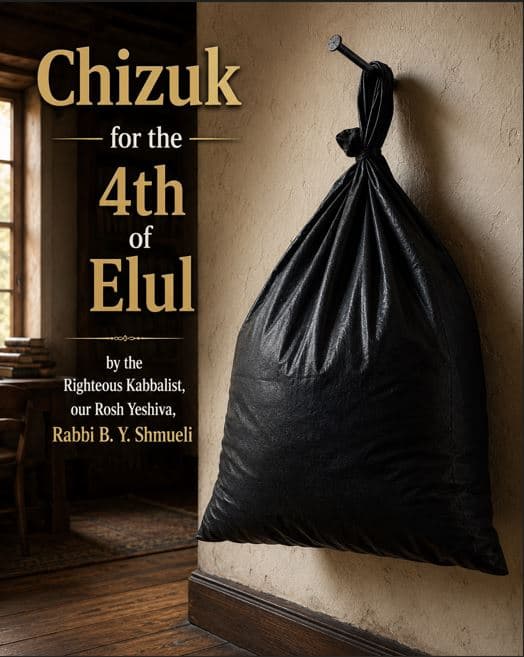
Chizuk for the 4th of Elul by the Righteous Kabbalist, our Rosh Yeshiva, Rabbi Benayahu Yissachar Shmueli
The son then offered the neighbor $10,000 just to buy rights to a single nail in her wall to hang his bag, with permission to enter whenever he needed. Seeing easy money, she agreed. Gradually, the son's visits increased. One day, he hung a basket containing raw poultry and fish on the nail and left it there. Within days, the meat rotted and created an unbearable stench. Because he legally owned the spot, the woman could not touch the bag. Eventually, the smell drove the woman and her family completely out of their own home. This is how the Yetzer HaRa operates: it asks for a tiny foothold—delaying morning prayer by just a few minutes—and slowly expands until it destroys a person's entire routine.
The Spiritual War of Elul
These days are like days of war—a direct battle between the Good Inclination (Yetzer HaTov) and the Evil Inclination (Yetzer HaRa). Every single moment, the Evil Inclination lies in wait. Hashem has given us the immense gift of the month of Elul, but the Yetzer HaRa wants us to lose it by disturbing our peace. We must utilize this time to work on ourselves calmly, with tranquility and joy, focusing especially on controlling our anger.
To succeed, a person must practice daily self-examination (Cheshbon Nefesh):
- In the morning: Ask yourself, "What am I going to do today? How will I serve Hashem? What am I striving for?"
- Before going to sleep: Reflect on what happened throughout the day.
Overcoming Anger: Rabbi Yechiel Michel of Zlotchov
Anger is one of the hardest traits to conquer. Rabbi Yechiel Michel of Zlotchov inherited a sacred pair of tefillin from his ancestors. People offered him a vast fortune for them, but even when he had no money for food, he refused to sell. His wife urged him repeatedly, "Sell the tefillin! We could buy ten houses for our children and ourselves, plus beautiful new kosher tefillin, and have a solid livelihood." Still, he refused.
One year during Sukkot, there were no etrogim available anywhere in the city. A merchant arrived with an exceptionally beautiful etrog and demanded the heirloom tefillin in exchange. Rabbi Yechiel Michel agreed to the trade and returned home dancing with joy.
When his wife learned he had traded the priceless tefillin for a single etrog, she was overcome with anger, grabbed the etrog, threw it to the ground, and invalidated it.
Instead of flying into a rage, the Rabbi began to dance even more. He declared: "The tefillin are gone, and now the etrog is gone—should I lose my temper and let the Evil Inclination win too?! Under no circumstances will it prevail over me!"
(Rabbi Yosef Voltoch, a descendant of Rabbi Yechiel Michel, would proudly sign his name noting this heritage).
The Tactics of the Yetzer HaRa & Parashat Amalek
The Holy Zohar teaches that a person's true enemy is the Evil Inclination, which attacks daily like a persistent fly—you chase it away, and it comes right back.
In Parashat Amalek, Moshe tells Yehoshua to go out and fight Amalek "tomorrow." The Yetzer HaRa uses this exact strategy of "tomorrow" (Machar):
- You decide to wake up early, go to Selichot, or attend yeshiva today.
- The Yetzer HaRa whispers: "Not today. Start tomorrow."
- When tomorrow comes, it says: "Wait until the beginning of the week."
- Then: "Wait for Rosh Chodesh."
- Finally: "Wait until after the holidays."
This trick of continuous postponement (Machar) keeps people stuck for fifty years. Notably, if you take the Hebrew letters of Machar (מחר) and look at the letters that immediately follow each in the alphabet:
- After Mem (מ) comes Nun (ן)
- After Chet (ח) comes Tet (ט)
- After Resh (ר) comes Shin (ש)
Rearranged, these form the letters of Satan (ש-ט-ן). There is no "tomorrow"—we must fight today.
King David and the Vindication at the Temple Gates
King David stated, "My heart is slain within me," meaning he had completely conquered his Evil Inclination. Yet after the incident with Bathsheba, David was bedridden and ill for twenty years. His enemies would stand outside his window and taunt him: "Disgrace! You sinned with Bathsheba!"
David prayed continuously: "Master of the Universe, strengthen me so they do not say I am sick because of sin, for my heart is clean!"
Eventually, Hashem healed him publicly and promised that his righteousness would one day be revealed to all. This promise was fulfilled generations later when King Solomon built the Holy Temple:
- When Solomon tried to bring the Ark into the Holy of Holies, the gates stuck together and refused to open.
- Solomon recited 24 songs of praise, but the gates remained sealed.
- Only when he prayed, "Remember the devotion of Your servant David," did the situation change.
According to the Midrash, Solomon went to his father's grave and called upon him. David arose from the grave in royal garments before the eyes of the entire world. As he approached, the gates swung open, angels sang, and the faces of David's mockers turned as black as the bottom of a pot—a mark that stayed with them forever.
If a person stumbles, they must drag their inclination directly to the House of Study (Beit Midrash); like stone against Torah, it will melt.
The Parable of the Neighbor's Nail
The Baal Shem Tov offered a parable to illustrate how the Evil Inclination gradually takes over:
A devoted son wanted to live near his elderly mother, but the neighbor living directly opposite her refused to sell her apartment at any price.
The son then offered the neighbor $10,000 just to buy rights to a single nail in her wall to hang his bag, with permission to enter whenever he needed. Seeing easy money, she agreed.
Gradually, the son's visits increased. One day, he hung a basket containing raw poultry and fish on the nail and left it there. Within days, the meat rotted and created an unbearable stench. Because he legally owned the spot, the woman could not touch the bag. Eventually, the smell drove the woman and her family completely out of their own home.
This is how the Yetzer HaRa operates: it asks for a tiny foothold—delaying morning prayer by just a few minutes—and slowly expands until it destroys a person's entire routine.
Yosef the Righteous, Modern Technology, and "Snatching" Mitzvot
Yosef defeated the constant temptations of Potiphar's wife because he engaged in daily self-examination (Cheshbon Nefesh, represented by the Hebrew word Chen / Grace).
Today, the Evil Inclination conquers people through small devices like smartphones that expose them to forbidden sights. Even in communities where technology is necessary for work, strict Rabbinical Court (Beit Din) oversight and filters are essential to prevent spiritual decline.
If the Evil Inclination snatches spiritual merit from you, you must snatch it right back:
- The Orphan in the Market: A poor orphan boy was selling homemade pastries on a large tray to buy food for his mother. A bully came by and kicked his tray, scattering the pastries onto the dirt. As onlookers began stealing the food off the ground, a bystander yelled to the crying boy: "Crying won't help! Grab what you can off the ground too!"
- The Lesson: When you fall or face a spiritual loss, do not despair. Grab whatever mitzvot and good deeds you can immediately reclaim.
The Cautionary Tale of the Wealthy Man's Son
Rabbi Shalom Shwadron related a true story about a legendary millionaire who owned fields, vineyards, and ships.
- The School Dispute: The wealthy man wanted his only son to study exclusively in a religious Cheder. His wife insisted on a secular school so the boy could learn a trade for financial security. Despite his wealth and trust in Hashem, his wife wore him down, and he compromised.
- The Town Fire & The Bank Guarantee: Ten years later, when the boy was 15, the town burned down. The community needed a 3-million-dollar bank guarantee to rebuild. The local Rabbi convinced the rich man to sign the guarantee, promising him that within 30 years the money would be fully repaid and he would see true salvation.
- The Son's Betrayal: By age 20, the son joined the family business. Manipulated by his mother, the son convinced his father to sign over all his factories and assets. Once in power, the son evicted his father from his office and demanded his parents move out of their villa into a small house.
- The Rabbi's Strategy: Heartbroken, the father turned to the Rabbi. The Rabbi revealed: "The 3-million-dollar bank guarantee you signed years ago has already been paid off by us, but no one knows this except you and me. I will have the bank send a legal foreclosure notice on all your remaining fields and vineyards for 'non-payment'."
- The Outcome: The bank seized the properties on paper, effectively rescuing the father's assets from his greedy son and placing them safely back in the father's hands.
The story illustrates the severe tragedy of failing to give children a proper Torah education focused on character refinement (Middot). Without spiritual grounding, spoiled children can turn on their own parents.
Concluding Prayer
The words of Chizuk concludes with the recitation of the verses of the prayer "Mi El Kamocha"