
Rabbi Benayahu Shmueli, Head of the Yeshiva: Chizuk for the 20th of Elul
We see this explicitly with King Menasheh. Menasheh engaged in every severe idolatry imaginable. The Talmud (Sanhedrin) notes that he erected massive idols requiring a thousand men to hold, crushing many in the process, and he erased Divine Names from Torah scrolls to write the names of pagan deities. Yet when he was placed inside a copper cauldron by his captors to be burned, he called out in repentance. Although the ministering angels tried to block his prayers, the Holy One, blessed be He, dug a secret tunnel beneath His Throne of Glory to accept Menasheh's repentance, miraculously delivering him.
The following is based on Rabbi Benayahu's Hebrew Chizuk video for the 20th of Elul, 5786.
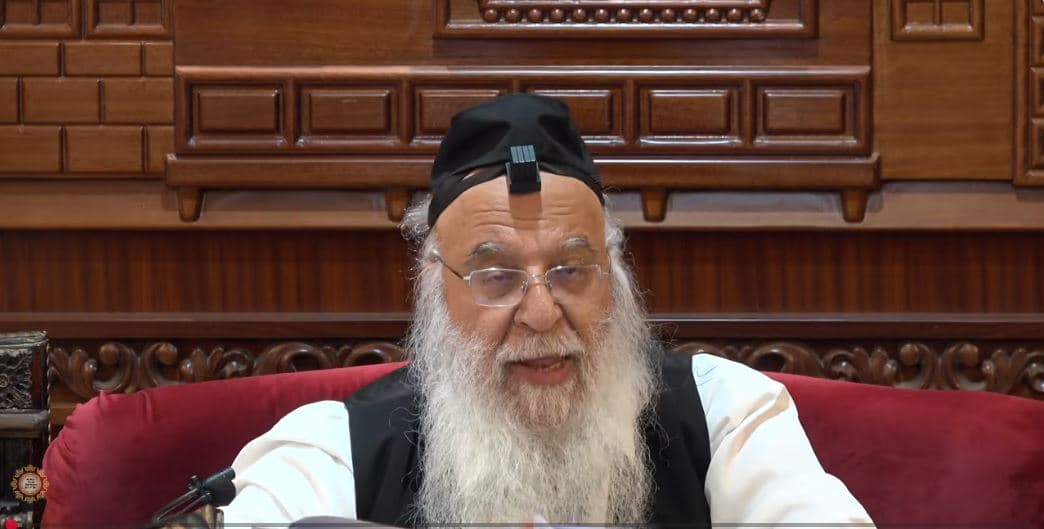
Opening Remarks and Commemorations
On Wednesday, the fourth day toward the holy Shabbat, the 20th of Elul, 5786 [September 2, 2026], we mark significant anniversaries of the passing of great righteous leaders: Rabbi Eliyahu Lopian; Rabbi Yosef Kahaneman (who served as the head of the rabbinical court and Rosh Yeshiva of Ponevezh); and our teacher and master, Rabbi Avraham Monsa. May their merit protect us and all the House of Israel, so that we may merit to perform complete repentance.
The month of Elul is the month of mercy and forgiveness. The Holy One, blessed be He, gave us this period as an extraordinary gift. How can a person receive such a gift and fail to utilize it? It is a privilege that determines how a person will be inscribed and sealed for a good life. The gates are open, and the King proclaims: "Enter, enter!" Yet the evil inclination attempts to let man dream, distracting his mind daily with new futilities. This world is full of desires and temptations, and man is simple-minded. One must open the eyes of reason to consider: What is man's role in his world? Why did he come, and what will he take with him?
Tomorrow, on Thursday, a general rectification (tikkun) for iniquities will take place here—a deeply beneficial spiritual act for the soul. We must seize these days to reflect rather than wander mindlessly.
The Parable of the King's Treasury
A story is told of a poor man who was in utter despair. To gladden his spirit, his rabbi advised him to walk along the seashore and watch the ocean waves. While walking along the shore, the poor man suddenly noticed a hand waving out of the water—a young man was drowning. He jumped into the sea, pulled the youth ashore, drained the water from his lungs, and revived him before calling an ambulance to take him for medical treatment.
It turned out that the person he saved was the King's son. Upon recovering, the prince insisted that his savior remain until the King arrived. When the King appeared, his son explained: "Father, this man saved my life! If not for him, I would have been gone." The King offered the poor man any reward he desired, but the man asked for nothing. The King then said: "I will give you a gift. You may enter my treasuries for one full hour; whatever you manage to take within that hour is yours!"
The King's ministers and noblemen were horrified, warning the King that the man would empty out the royal treasures. To prevent this, they consulted a clever advisor who devised a strategy: "Let us find out what this man loves—what he likes to eat, what music he enjoys." They discovered that he was exceptionally fond of fine food and orchestral music.
Before the poor man entered the treasury, the royal ministers set up elaborate displays of American, Persian, and Moroccan cuisines prepared by top chefs, alongside attentive waiters and world-class orchestras playing music. As the man walked toward the treasury, the music captivated him, and the aroma of roasted meats and fine spirits aroused his appetite. He decided to stop and taste the delicacies. One dish led to another, accompanied by wine and celebrations.
Suddenly, as he finally stepped toward the treasury door, the guard stopped him and declared: "Sir, your hour has passed!" Due to his worldly lusts, he lost all the treasures that could have changed his life forever.
This is precisely how the evil inclination operates with us. Every day it presents something new—a new drive, a new trip, a brief rest—distracting us while life slips away in futility. One must recognize that the evil inclination works non-stop and must be fought continuously.
The Path of Repentance and Mussar
The Talmud teaches that intermediate people (beinonim) remain suspended until Yom Kippur. It is an absolute obligation upon every person to repent; failing to do so is itself a sin. To achieve true repentance, one requires daily ethical study (mussar) to reflect upon one's life and engage in honest self-accounting. Without studying works such as Sha'arei Teshuva or Iggeret HaTeshuva by Rabbeinu Yonah, how can a person properly evaluate his soul?
Chacham Ovadia related a story involving Reb Bunim of Peshischa and the Seer of Lublin (Chozeh M'Lublin). The Seer once visited Reb Bunim and found his eyes red and tearing from crying. When asked why he was weeping, Reb Bunim replied: "A certain person insulted me." The Seer asked what he did to the one who insulted him, to which Reb Bunim answered: "I kissed him!" When the Seer asked who it was, Reb Bunim revealed: "It was the book Shevet Mussar! I read it, and I felt so deeply insulted by how far I am from properly keeping the commandments that I wept—and when I finished, I kissed the book."
Gematria and the Spiritual Depth of Elul
Repentance (teshuva) represents Tashuv Hei—returning the letter Hei, which corresponds to the Divine Presence (Shechinah) and the realm of Kingship (Malchut), back to its proper source. The realm of Repentance resides in Understanding (Binah), which shares the numerical value (gematria) of the word Elul [אלול = 67].
This concept is rooted in the verse where Yaakov says to Yosef: "And I have given to you one portion (Shechem) above your brothers, which I took from the hand of the Amorite with my sword and with my bow" (Genesis 48:22). As our Sages explain, "my sword and my bow" refers to prayer and supplication. Yosef represents the Foundation (Yesod) of everything, and Yaakov granted him Shechem [שכם], which has a numerical value of 360, corresponding to the Shovavim periods.
Furthermore:
- The word "And I" (Va'ani - ואני) equals 67 (Vav [6] + Aleph [1] + Nun [50] + Yud [10]), which is the exact gematria of Elul [אלול = 67].
- The word "I have given" (Natati - נתתי) equals 860. When calculated with the kollel (the word unit itself), it equals 861. This corresponds exactly to the numerical value of Rosh Hashanah [ראש השנה]: Reish (200) + Aleph (1) + Shin (300) + Hei (5) + Shin (300) + Nun (50) + Hei (5) = 861.
Because the numerical value of Elul equals Binah (67), the World of Repentance and the Throne of Glory—which resides in Binah within the World of Creation (Beriah)—are directly accessible during this month. At any other time of the year, reaching this spiritual height requires immense labor; during Elul, the gateway is right before us.
Offerings, Prayer, and the Letters of the Alphabet
Because we lack physical sacrifices today, we recite the Torah section of the Offerings (Korbanot), fulfilling the verse: "And we shall offer the prayer of our lips in place of bulls" (Hoshea 14:3). Prayer serves in place of the burnt offerings, sin offerings, and thanksgiving offerings.
The Tosafot note that ELUL [אלול] serves as an acronym for Echad Le'olah Ve'echad Lechatat ("One for a burnt-offering and one for a sin-offering"). In Elul, every Jew trembles at the thought of sin. If a person repents, he ascends (olah); if he fails to elevate himself, he descends.
The power of simple prayer is illustrated by a story from the time of the Baal Shem Tov. The Baal Shem Tov's shofar blower had prepared all the complex mystical intentions (kavanot) written on a piece of paper. Right before the blowing, the Baal Shem Tov secretly took the paper away. Finding himself without his notes, the man was heartbroken and simply meditated on the letters of the Hebrew alphabet (Aleph, Bet...) with total sincerity. Afterward, the Baal Shem Tov told him that his shofar blasts had elevated above everything, explaining that the pure simplicity of the Aleph-Bet combines all the Divine Names.
Similarly, the Ben Ish Chai prescribed a prayer based on reciting the entire 27-letter Hebrew alphabet (including final letters, representing Zach [זַךְ = 27]) 27 times, followed by the primary vowels 9 times. This practice unites all the finest supplications in the world, which is why we incorporate these Aleph-Bet recitations into our tikunim.
Parable of the First-Class Passenger
The Chafetz Chaim told a story about a villager who had never ridden on a train. When a new railway line opened, he saved his money over a long period to buy a ticket. Wanting the best experience, he paid a large sum for a first-class (business) ticket.
However, being unfamiliar with trains, the foolish man wandered to the very last carriage where livestock were kept and where thieves hid to avoid the conductor. Accustomed to farm life, the villager sat down among the animals and thieves.
When the inspector arrived, the thieves hid among the livestock, and the villager tried to hide as well. The inspector kicked him and demanded: "What are you doing here? Show me your ticket!" When the inspector looked at the ticket, he saw it was a first-class pass. He exclaimed: "You fool! You paid for first-class business accommodations, and you are sitting here in the dirt with livestock and thieves?!"
During the month of Elul, we are given a first-class opportunity to enter the King's palace, draw close to Hashem, and repent. We must not act foolishly by remaining in spiritual filth when a supreme ticket has been placed in our hands.
The Power of Repentance and King Menasheh
The phrase "A lion (Arieh) has roared, who will not fear?" (Amos 3:8) contains the acronym Arieh [אריה]: Elul, Rosh Hashanah, Yom Kippur, Hoshana Rabbah. Only someone with a heart of stone or spiritual deafness fails to tremble.
The Sages teach: "In the place where repentant sinners stand, complete righteous people cannot stand." The Throne of Glory resides in the World of Creation, surrounded by ranks of fiery angels. When a wicked soul approaches, angels of destruction normally push it away due to its spiritual impurity. But when the Holy One, blessed be He, sees that a person genuinely desires to repent, He digs a special underground tunnel beneath the earth directly to the Throne of Glory. While the righteous stand behind the ranks of angels, the repentant sinner is brought through this hidden tunnel right next to the Throne itself. The righteous ascend step-by-step, but the repentant sinner is elevated instantly via a spiritual expressway.
We see this explicitly with King Menasheh. Menasheh engaged in every severe idolatry imaginable. The Talmud (Sanhedrin) notes that he erected massive idols requiring a thousand men to hold, crushing many in the process, and he erased Divine Names from Torah scrolls to write the names of pagan deities. Yet when he was placed inside a copper cauldron by his captors to be burned, he called out in repentance. Although the ministering angels tried to block his prayers, the Holy One, blessed be He, dug a secret tunnel beneath His Throne of Glory to accept Menasheh's repentance, miraculously delivering him.
When the angels questioned why human beings—who are destined to sin—should receive the Torah, Moshe held onto the Throne of Glory and answered them that Hashem created Repentance even before the world existed, proving that Hashem's mercy is open to all who return.
Deeds of the Righteous: Rabbi Eliyahu Lopian and Rabbi Yosef Kahaneman
Rabbi Eliyahu Lopian possessed incomparable dedication to Torah study, profound prayer, and merit to experience revelations of Eliyahu the Prophet. He served as Rosh Yeshiva of Knesset Chizkiyahu (originally in Zichron Yaakov and later in Kfar Hasidim), knew all six orders of the Mishnah by heart, and studied Kabbalah with the holy Leshem. He passed away in 1970 (5730) at the age of 94.
A story is told that a prospective student arrived at Rabbi Lopian's home in the middle of the night. Rabbi Lopian welcomed him warmly, fed him, gave him a bed, and covered him. As the student lay in bed, he overheard Rabbi Lopian repeating aloud for an entire hour: "You shall not bring an abomination into your house!" The student wept, assuming the Rabbi was referring to him as an abomination.
In the morning, Rabbi Lopian woke the student gently for prayers and brought him a glass of milk. After prayers, the student tearfully asked why the Rabbi had called him an abomination. Rabbi Lopian was shocked and explained: "Heaven forbid! I did not know you could hear me. Every morning before I enter the study hall, I am terrified that the Evil Inclination will entice me with pride. Therefore, I repeat to myself that pride is an abomination, so that I never succumb to arrogance!"
We also commemorate Rabbi Yosef Kahaneman, the Ponevezher Rov, who studied in Radin under the Chafetz Chaim. After delivering the eulogy for Rabbi Itzele of Ponevezh, he was chosen to succeed him and served as Rabbi of Ponevezh for 26 years until the Nazi invasion. Arriving in the Land of Israel in 1940 (5700) amidst horrific news of the Holocaust, he built the Ponevezh Yeshiva on a grand, unprecedented scale.
He also established rescue institutions for Holocaust survivor children (the "Tehran Children"), creating boarding homes known as Batei Avot, as well as Yarchei Kallah study programs for working laymen.
To raise funds, he once visited a wealthy man who offered a million-dollar donation on one condition: that the students not wear yarmulkes. Rabbi Kahaneman immediately agreed and took the check. When the donor later came to inspect the institution, Rabbi Kahaneman led him through his massive girls' educational institution, showing him thousands of female students and stating: "Here are your students—they don't wear yarmulkes!"
The Legacy of Rabbi Avraham Monsa
We also mark the memorial of Rabbi Avraham Monsa, whom the Rosh Yeshiva always treated with royal honor. Rabbi Monsa grew up in Aleppo in severe, destitute poverty alongside his brother, Rabbi Yosef, and his father.
Following his mother's passing, food was scarce. His father would occasionally bring home a single piece of bread and tell the boys: "Let me test how you studied today. If you did not study properly, I will eat the bread; if you studied well, you will eat it." They experienced extreme poverty, often going to sleep hungry and relying entirely on Hashem's mercy.
Rabbi Monsa authored the work Padeh Et Avraham, containing beautiful and profound Torah insights. May the merit of all these righteous tzaddikim protect us and all of Israel. Amen.