
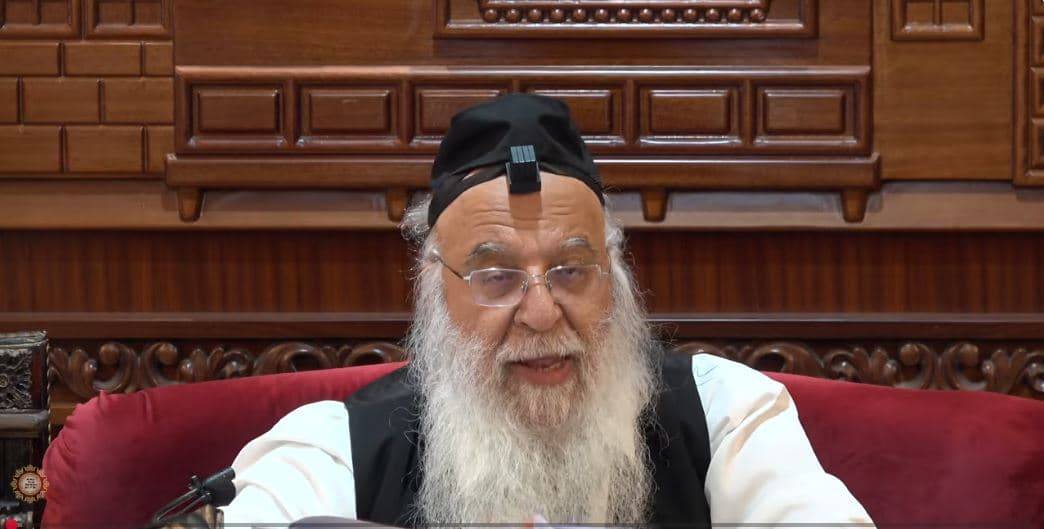
Rabbi Benayahu Shmueli, Head of the Yeshiva - Chizuk for the 7th of Nissan
The following is based on Rabbi Shmueli's Hebrew Chizuk video for 7 Cheshvan 5787
Parashat Noach and Lech Lecha, Faith, and Providence
Introduction: Seasonal Blessings, Global Events, and the Month of Cheshvan
On the first day of holy Shabbat, the seventh of Cheshvan, 5787, we began reciting "Barech Aleinu" ("Bless for us, Hashem our L-rd, this year... give dew and rain for a blessing upon all the face of the earth"), praying for abundance across the world so that everything might be conducted in tranquility and joy.
When we look around the world, we see massive upheavals. In Turkey, for example, devastating floods have destroyed thousands of stores, sending rushing waters inside, causing massive structural damage, washing cars away through the streets, and resulting in losses amounting to millions. Yet here, in the land of Israel, we experience the verse: "And give dew and rain for a blessing," for the land of Hashem—the eyes of Hashem your L-rd are upon it from the beginning of the year to the end of the year. Similarly, in Russia, unprecedented snow floods have struck—phenomena unseen for decades—alongside a massive earthquake registering magnitude nine on the Richter scale that reached as far as Japan. Although that specific epicentral area lacked permanent housing, it was a colossal tremor.
All these global events serve as a call for us to return in repentance. In France, thousands of protesters have flooded the streets of Paris, looting stores. In the United States as well, large-scale storms, and disruptions have displaced thousands from their homes. In Colombia, severe floods have struck, and a hurricane has hit Greece. Yet the people of Israel remain secure, though we must always learn the moral lessons behind these events.
We are currently in the month of Cheshvan, often called Mar (bitter). One reason for this name is that the autumn droplets—the rain—begin to descend during this month. This connects to the verse in Yishayahu chapter 40: "Behold, the nations are as a drop from a bucket" (hen goyim k'mar midli). Others explain that it is called Mar because Methushelach passed away during this month, or because Rachel our Mother passed away in Cheshvan. It was certainly not a sweet time for her.
Parashat Noach and Historical Parables
We remember how the Holy One, Blessed be He, destroyed the generation of the Flood. Afterward, when humanity journeyed eastward to build a tower with its top in the sky, Hashem scattered them so that no man understood the speech of his fellow, transforming some into monkeys or elephants. This is why our Sages instituted the blessing recited upon seeing such creatures: "Blessed is He who alters the creations."
Today also marks the yahrtzeit of Rabbi Meir Shapiro of Lublin, the visionary founder of the Daf Yomi global Torah-study initiative—a truly great and holy day, though a profound loss to the Jewish world. Alongside our study of Parashat Noach and Rashi's commentary (having already completed our unit testing), we must also delve into the profound teachings of the Bnei Yissachar concerning eternal laws. Furthermore, this week we commemorate the passing of Rachel our Mother, to whose resting place we will journey together.
The Miracle of the Showbread and the Journey to Morocco
The Talmud relates that when the people of Israel ascended to Jerusalem on pilgrimage, the Kohanim would exhibit the showbread (lehem hapanim) to the crowds. This demonstrated a grand miracle: although the bread had been baked and placed on the table a week prior, when lifted before the pilgrims, it was as piping hot as if it had just been removed from the oven. This visual display proclaimed to the pilgrims: "See how cherished you are before the Omnipresent."
The Sages explain a deeper lesson here: just as a person emerges from the spiritual warmth of the Days of Awe (Rosh Hashanah and Yom Kippur), that inner spiritual heat must be sustained. One must continue forward with yearning and warmth.
To illustrate the boundless reach of divine assistance and spiritual passion, a wondrous story is told regarding the scholars of Beit El. Once, the sages of Beit El encountered an immensely difficult Torah query that they could not resolve. They were told that a supreme Torah genius lived far away in Morocco—Rabbi Avraham ben Diwan. Seeking his counsel, they drafted a written question, hired a non-Jewish messenger with a donkey, and instructed him to embark on the grueling, multi-month journey across continents to Morocco, promising to cover all his expenses.
The messenger endured a punishing journey across rough terrain, suffering from exhaustion and severe back pain. Upon finally arriving in Morocco, he searched extensively until he located a simple home where a man was out plowing and hoeing the earth. The messenger approached him, stating, "I am looking for the great genius sent by the community of Beit El, Rabbi Avraham ben Diwan."
The farmer smiled—for it was none other than Rabbi Avraham himself. He stepped inside briefly to compose himself, then emerged and asked, "How can I help you?"
The messenger gasped, "Are you truly him?"
"Yes," the sage replied. "Bring me the question."
Rabbi Avraham took the parchment, turned it over, and instantly penned a brilliant, definitive response on the reverse side. Meanwhile, his wife was pulling fresh, hot bread from the oven. Offering the messenger a loaf, Rabbi Avraham urged him, "Continue on!"
The exhausted messenger protested, "Continue on? I have spent months traveling on a donkey across deserts with a broken back; I need to lie down and sleep in a proper room!"
"Continue on!" Rabbi Avraham insisted firmly. "Did I not tell you to continue?"
The messenger didn't know what to do. Suddenly he starts walking. He sees himself down in Beit El.
He found himself instantly transported back down to Beit El, holding the warm loaf of bread fresh from Morocco! The sages of Beit El examined the response, marveling at the wonders upon wonders orchestrated by Heaven.
The Early Life and Trials of Avraham
The Torah narrative continues with the journey of Terach, who took his son Avram, his grandson Lot (son of Haran), and his daughter-in-law Sarai from Ur of the Chaldeans to settle in Haran. One opinion held that it was just to distance themselves from the wicked leaders of the Chaldeans. However, there is an additional view.
When Avram was born, the royal astrologers of King Nimrod came with grave warnings. They reported seeing four mighty celestial stars from the four corners of the heaven locked in combat, until a small star rose from the east and swallowed them all. They interpreted this as an omen that a child was born who would ultimately challenge and defeat Nimrod. Stricken with panic, Nimrod decreed that all newborn boys must be eradicated.
To save her newborn son, Avram's mother hid him underground for thirteen years, where he was miraculously sustained by Heavenly messengers. Furthermore, when Terach's wife was pregnant, royal inspectors attempted to examine her womb, but Hashem miraculously shifted the fetus within her body so that it remained completely undetected. When the time came for her to give birth, she retreated to a remote wilderness. After caring for the infant for a single day, she entrusted him to Divine care, swaddling him and leaving him sheltered while angels from Heaven provided him with sustenance. Within a mere ten days, the infant miraculously matured into a young man of twenty.
When Avram emerged, he was already equipped with profound wisdom and fearless clarity. Reconciling with his mother years later, he revealed his identity, explaining that the Creator of the sun, moon, and stars had sustained him. Fearless of Nimrod and his idols, Avram boldly confronted the tyrant, denouncing his idolatry and asserting the absolute sovereignty of the one true G-d. Despite the immense challenges, Avram succeeded in bringing thousands of souls under the wings of the Divine Presence. Although Sarai was naturally barren, they continuously drew lost souls out of spiritual impurity and sheltered them in holiness.
When Hashem ultimately commanded Avram, "" Go from your land, from your birthplace, and from your father’s house... to the land that I will show thee," Avram did not hesitate, despite having thriving businesses, properties, and academies established in Haran. When his disciples and followers asked where he was going, he answered simply that he was following the word of Hashem. Whoever wished to join him accompanied him—men, women, and children—abandoning all worldly attachments out of pure trust in the L-rd of Hosts.
Trust in Hashem (Bitachon) and Lessons from the Pele Yoetz
In discussing the nature of absolute trust in Hashem, the revered ethical work Pele Yoetz outlines a fundamental principle: true trust (bitachon) does not mean demanding that Hashem fulfill our specific personal desires or guarantee that we will never experience hardship. After all, many righteous individuals, pious paupers, and innocent scholars endure severe physical suffering and poverty.
Instead, the Pele Yoetz teaches that true trust means knowing with absolute certainty that everything the Merciful One does is ultimately for the good. Even when facing harsh decrees, a person must realize that Hashem looks into the human heart and orchestrates events with perfect wisdom.
A striking illustration of this principle unfolded during the era of the Shah of Iran, prior to the rise of Khomeini’s regime. A wealthy Jewish family residing in Persia—renowned for their gold trade and prosperity—suffered a sudden tragedy when Khomeini’s soldiers overran their business and executed the head of the household. His wife was left a destitute widow with young children, facing certain persecution unless she fled immediately.
Abandoning all their vast wealth, the widow resolved to escape across the rugged borders toward Turkey and ultimately reach the safety of the Land of Israel. She entrusted half of all her remaining valuables to a smuggler who promised to guide her via camels and donkeys through treacherous mountain passes.
Along the way, violent bandits ambushed the travelers, stripping her of her remaining jewelry and precious stones. Undeterred, the widow declared, "This loss is insignificant; I am pressing onward." The journey required traversing dizzying rope bridges, navigating freezing mountain rivers barefoot over sharp stones, and crossing deep abysses. Whenever the non-Jewish guide threatened to abandon or harm the travelers if they lagged behind, they forced themselves forward through sheer terror and determination.
At the final Turkish border checkpoint, the guide suddenly pulled the widow aside and revealed a stunning secret: "Know this—I am actually a Jew. I deliberately made the journey harsh and uncompromising because I knew that without that intense pressure and discipline, you would never have survived the dangers of the route. Because I admire/like you, take back every single coin and valuable you paid me. Take your children and go in peace to the Land of Israel, knowing that these trials are merely the birth pangs of redemption." Through her unwavering trust and endurance, that widow successfully reached Israel, establishing a thriving, multi-generational family.
The Power of Atonement and Reincarnation: Teachings of Rabbi Shalom (Messas?)
Addressing the mysterious ways of divine justice, Rabbi Shalom shared a profound parable regarding human interactions and heavenly accountability. He noted the grave warning that whoever strikes the cheek of a fellow Jew commits a severe transgression, as though striking the Divine Presence itself.
He recounted the case of a righteous man who had once committed this offense out of anger. When his soul ascended to the Heavenly Court, he was presented with two options for cleansing his spiritual blemish: enduring the fires of Gehinnom for spiritual purification, or returning to the physical world through reincarnation to rectify the deed. Terrified of repeating the sin, he initially chose Gehinnom. However, upon witnessing the intense spiritual anguish of that realm, he cried out, "Please, let me return in a physical reincarnation!"
The Heavenly Court granted his request but it was under one condition: to achieve complete atonement, he would be born physically impaired—specifically with a severed or missing hand—so that he would never again be capable of striking another person. True to this decree, the child was born missing a hand. Throughout his youth, he struggled with agonizing questions regarding why he was born this way, until a master of truth revealed to him that his soul had specifically requested this rectification from Heaven to cleanse its past blemish.
In a similar vein, Rabbi Shalom recounted the engagement of a pious young man who walked with a noticeable limp. When he met his prospective bride, she noticed his physical condition and hesitated, telling her father that she could not bear to marry someone with a physical disability.
Upon hearing this, the young man gently explained: "Listen to the truth. In the upper spiritual realms before our descent to this world, I was shown your soul and saw that you were destined to face physical challenges. I stepped forward and declared that I would willingly carry this physical burden in this world so that you could be spared, and that my lifelong dedication to Torah study would merit us both health and happiness. But if you truly do not wish to accept me, go your separate ways in peace." He also hinted that if the match did not go through, Hashem might revert to the original plan that she would have the disability. The woman accepted his words, and they built a blessed life together.
The Sheild of Avraham
Rabbi Shimon ben Lakish teaches in the Talmud (Pesachim 117b) regarding Hashem's blessing to Avraham:
- "And I will make of you a great nation" is fulfilled in the opening blessing of the Amidah (L-rd of Avraham).
- "And I will bless you" corresponds to L-rd of Yitzchak, honoring the eternalization of a father's legacy through his descendants.
- "And I will make your name great" corresponds to the L-rd of Yaakov.
Although one might have thought that the opening blessing of the Amidah should conclude by naming all the patriarchs together, the verse explicitly concludes: "...and you shall be a blessing"—indicating that the blessing is sealed through Avraham alone, ending with the formula: "Shield of Avraham."