
Rabbi Benayahu Shmueli, Head of the Yeshiva: Chizuk for the 13th of Elul and the Hilula of Rabbi Yosef Chaim the Ben Ish Chai
When his father, Rabbi Eliyahu Chaim, passed away at the young age of forty-eight, Rabbi Yosef Chaim was only twenty-six years old. Upon delivering his father's eulogy, the community immediately recognized his spiritual authority and begged him to lead them. He accepted the responsibility of guiding the community of Baghdad, though he steadfastly refused an official title or salary.
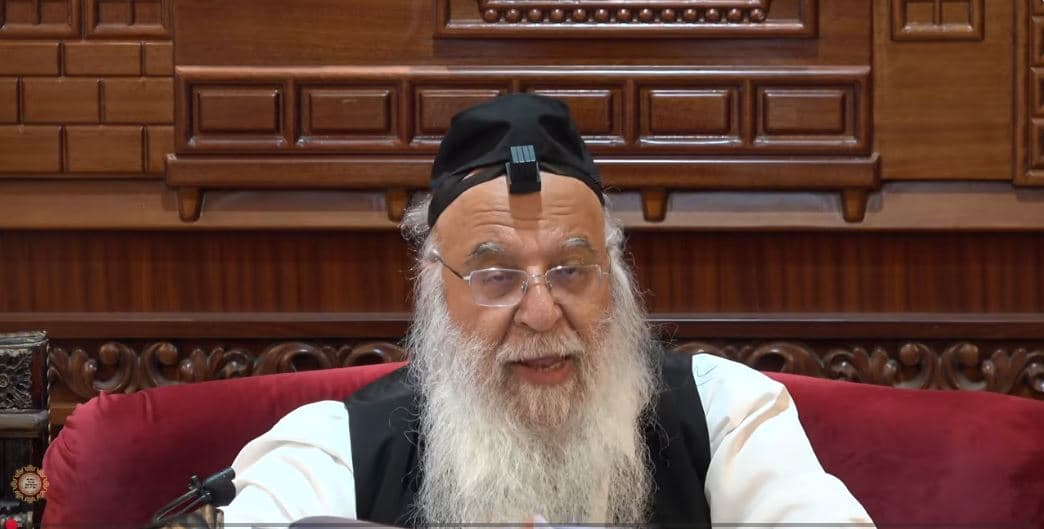
The following is based on the Hebrew Chizuk video of Rabbi Shmueli for the 13th of Elul
Commemoration of Rabbi Yosef Chaim (The Ben Ish Chai)
Today is Wednesday, the fourth day of counting towards Shabbat, corresponding to the 13th of Elul, 5786 (2026). This day marks the Hilula—the anniversary of the passing—of our teacher, master, and head of the Diaspora, the great Gaon and public merit-bringer, Rabbi Yosef Chaim, son of Rabbi Eliyahu (may his merit protect us and all the House of Israel). He is renowned as the author of Ben Ish Chai, Rav Pe'alim, and Kavtziel, and he merited to multiply Torah throughout the world in an extraordinary manner.
During the month of Elul, Rabbi Yosef Chaim had a sacred custom to isolate himself in prayer at the tomb of the Prophet Yechezkel. It was on this journey, while traveling in extreme heat without sufficient hydration, that he suffered severe dehydration and passed away on the road at the age of seventy-five. Born on the 27th of Menachem Av, 5594 (1834), his holy soul departed in the year 5669 (1909).
The Nature of Repentance and the Softening of Decrees
In his commentary Benayahu Yada on Tractate Rosh Hashanah, Rabbi Yosef Chaim addresses the Talmudic statement: "Great is repentance, for it tears (makra'at) a person's harsh decree." He questions the choice of the word makra'at, which specifically denotes cutting something into numerous small fragments or pieces (kera'im). He explains this through two insightful parables:
- The Parable of the Timber Beam: A father became deeply angered by his son's repeated wrongdoing and swore, "I swear I will throw this massive beam (kora) at you!" Upon cooling off, the father realized that throwing such a heavy beam would kill his son, yet he could not break his oath. The Admor of Karlin advised him to take the beam and saw it into tiny wooden fragments. By throwing the beam piece by piece over time, the father fulfilled his oath while ensuring his son remained unharmed.
- The Parable of the Boulder: Similarly, a father vowed to throw a massive boulder at his son. To spare his child, he ground the boulder into fine gravel and threw it one tiny pebble at a time, rendering the impact imperceptible.
This illustrates the attribute of Divine Mercy. When a person transgresses, a severe decree may be issued; however, through repentance, the Holy One, blessed be He, divides the punishment into minuscule, manageable parts delivered over time so the person is not destroyed. The Hebrew word for tear—Kara (קרע)—shares its root letters with Akar (עקר), meaning to uproot. Through this process, the decree is dismantled, bringing true healing and salvation (Veshav verafa lo).
The Power of Esoteric Torah Study
Addressing the verse, "The voice is the voice of Yaakov, but the hands are the hands of Eisav," the Talmud notes that when the voice of Yaakov chirps (metzafztef) in synagogues and study halls, the power of Eisav's hands is nullified. Rabbi Yosef Chaim questions why the Sages chose the specific verb "chirps" rather than simply stating "prays" or "studies."
He explains that what possesses the unique strength to reduce the physical power of Eisav to dust is the study of the secrets of the Torah—the Kabbalah and the holy Zohar. When an observer hears scholars immersed in these esoteric secrets, discussing concepts such as Z'UN, Abba V'Imma, Da'ati, and ChaGa'T, the terminology sounds completely incomprehensible, akin to the chirping of birds. It is precisely this profound, secret wisdom that tears through heavenly spiritual barriers and nullifies all adversity.
Anecdotes of Holy Conduct and Early Genius
Hakham Yitzchak Kaduri frequently shared memories of Rabbi Yosef Chaim, describing his early life, righteousness, and extraordinary piety.
Early Sharpness and Devotion
Even as a child (Yanik VeChakim), Yosef displayed immense wisdom:
- Answering his Father: At four years old, his father asked him why Hashem called out to Adam in the garden asking Ayeka ("Where are you?"), given that nothing is hidden from the Almighty. Young Yosef replied that Ayeka (איכה) serves as an acronym for Ani Yodea Kol Hanistarot ("I know all secrets")—meaning Hashem was asking, "Why do you attempt to hide?"
- The Order of Havdalah: On Saturday nights, Yosef would race his sister to bring his father the Havdalah supplies. When his father asked him to justify the mnemonic Yavneh—Wine (Yayin), Spices (Besamim), Candle (Ner), and Havdalah—Yosef explained that it follows the ascending order of the senses: taste (wine), smell (spices), sight (candle), and finally the mind and intellect (Da'at) to distinguish between the holy and the profane. Delighted by his logic, his father granted him the privilege.
Secret Acts of Charity
Each Friday, his father gave the children a small allowance to purchase Sabbath treats like Mann al-Sama (a sweet delicacy), raisins, or nuts to bless over at the table. While his siblings presented their treats, Yosef repeatedly claimed he had already eaten his. Suspicious, his sister followed him into the city and discovered that he was using his allowance to buy tobacco and eshtanur bread, which he secretly delivered to an impoverished elderly woman in the Jewish quarter. Upon learning of his selflessness, his father doubled his allowance so he could continue his charitable work.
Extreme Piety and Self-Restraint
Rabbi Yosef Chaim's daily conduct reflected angelic piety. His writings detail elaborate spiritual intentions (Leshem Yichud) for routine actions—including proper mindset during meals, personal hygiene, and prayers for livelihood. On Shabbat, his table was surrounded by holiness, complete with Zoharic insights and ritual honor shown to his family, such as kissing his mother's hands.
His ascetism was equally legendary. During the Iraqi heat, he refused to enjoy fresh watermelon during the summer season. Instead, he would wait until Rosh Hashanah to recite the Shehecheyanu blessing over a piece that had already become spongy, deliberately eschewing physical pleasure. Furthermore, he undertook a six-year period of severe penance (Kanah), abstaining from meat and wine while afflicting himself with ascetic fasts.
Leadership in Baghdad and Preaching in Tsalat al-Kabiri
When his father, Rabbi Eliyahu Chaim, passed away at the young age of forty-eight, Rabbi Yosef Chaim was only twenty-six years old. Upon delivering his father's eulogy, the community immediately recognized his spiritual authority and begged him to lead them. He accepted the responsibility of guiding the community of Baghdad, though he steadfastly refused an official title or salary.
Beginning in the year 5620 (1860 CE), he delivered regular sermons at the Great Synagogue (Tsalat al-Kabiri). Hakham Yitzchak Kaduri recalled attending these lectures alongside thousands of listeners:
- The Unique Voice: Rabbi Yosef Chaim would preach uninterrupted for four hours, blending legal rulings (Halakha) with narrative lore (Aggadah). Without modern amplification, his voice rang out so clearly that a crowd of ten thousand men heard every word perfectly.
- Presence and Reverence: The atmosphere was charged with holiness; Hakham Kaduri noted that the Divine Presence seemed to speak directly from his throat, and once, when a child fell from the roof during a massive gathering, he was unharmed.
- Guardianship of Modesty: Rabbi Yosef Chaim went to extreme lengths to avoid immodesty. While walking through market alleys accompanied by his son, Hakham Yaakov, he would take long detours to avoid passing female street vendors. When his son once suggested a quick passage, Rabbi Yosef Chaim uttered a sharp stern sound, causing the vendors to scatter immediately, reminding his son never to compromise on personal boundaries.
The Story of Rabbi Avraham the Carpenter
In his work Od Yosef Chai, Rabbi Yosef Chaim shared a favorite parable illustrating Divine Providence:
Rabbi Avraham was a pious, simple carpenter banwho spent his earnings generously to honor the Sabbath and support Torah scholars. Before traveling far with his family to attend a wedding, he left his accumulated fortune locked in a single box in his house. Seeing the home empty, a wicked neighbor broke in, stole all the money, and fled toward the village of Ein Gedi to hide the gold. En route, the thief collapsed and died.
A villager named Efraim discovered the thief's body and found the bundles of gold dinars. Efraim brought the wealth home, but that night he dreamt he was warned: "Do not touch this money, for it was stolen from a faithful man, and it must return to its rightful owner." Dismissing the dream as a false vision, Efraim set off to visit his dying father.
Anxious about bandits along the road, Efraim hid the heavy gold inside a hollow tree trunk in a garden, covering the opening with wood. While he was mourning his father's subsequent death, a violent storm uprooted the tree. Later, a poor man collecting wood gathered the fallen trunk and brought it to Jerusalem, where he sold it to Rabbi Avraham the Carpenter. Upon sawing into the log, Rabbi Avraham discovered his stolen treasure intact and offered thanks to Hashem.
Years later, having fallen into poverty, Efraim traveled to Jerusalem looking for work and was hired by Rabbi Avraham. As they conversed, Rabbi Avraham recounted how Hashem had miraculously restored his stolen wealth inside a hollow tree. Realizing the full truth of his original dream, Efraim marveled at how Divine Providence ensures that what belongs to a righteous person inevitably returns to them.
Journey to the Land of Israel and Holy Connections
Rabbi Yosef Chaim traveled to the Land of Israel to cherish its holy soil and connect with its sages.
Miraculous Events on the Road
- The Sudden Mikvah: While traveling with his brother, Rabbi Yosef Chaim expressed a desire to immerse in a mikvah (ritual bath) before proceeding. When his brother noted there was no body of water nearby, Rabbi Yosef Chaim instructed him to dig in the earth. Water immediately welled up, allowing them to immerse before continuing their journey.
- Halachic Integrity and the Robbers: On a Friday afternoon, an Arab driver refused to halt his carriage for Shabbat. Unwilling to violate the holy day, Rabbi Yosef Chaim had a tent pitched in the desert to observe Shabbat. Bandits approached the tent with intent to harm the travelers, but their leader recognized Rabbi Yosef Chaim. The leader recalled an instance where Rabbi Yosef Chaim had ruled that a Jewish man was obligated to pay a large debt owed to a Gentile; when the Jewish man could not afford it, Rabbi Yosef Chaim paid the debt out of his own pocket. Realizing he was in the presence of a truly holy man, the bandit leader ordered his men to protect the tent.
- Composition at Meron: Visiting the tomb of Rabbi Shimon bar Yochai in Meron, Rabbi Yosef Chaim composed the famous hymn A Holy Man of the L-rd Is He (Bar Yochai). A wealthy admirer was so moved that he had the lyrics inscribed on a golden plaque.
Interactions with Sages
While in Jerusalem, he visited the Kabbalistic Yeshiva Bet El and met with Rabbi Yedidya Rafael Abulafia (the Yere). When he departed for Hebron to visit its Chief Rabbi, Eliyahu Mani—whose charitable work and leadership were personally funded through monthly stipends sent by Rabbi Yosef Chaim's family—the Yere summoned him back. By the time Rabbi Yosef Chaim returned to Jerusalem, the Yere had passed away by Heavenly decree.
Rabbi Yehoshua Sharabani later recounted standing outside the windows of Rabbi Yosef Chaim’s home in Baghdad just to hear the daily original Torah insights (Benaiah and Benaiah Yahuida) that the Rabbi taught to the needy whom he fed at his table. Rabbi Sharabani also recalled how Rabbi Yosef Chaim possessed remarkable spiritual insight; when Sharabani once attempted to interrupt his private attic study session with a difficult scholarly question, Rabbi Yosef Chaim emerged before he reached the top of the stairs, correctly identifying the exact texts (Maharash Ashkenazi) Rabbi Sharabani was referencing and addressing them directly.
Heavenly Revelations and Familial Legacy
Levels of the Soul
Hakham Shimon Darzi recounted that after Rabbi Yosef Chaim was told in a dream that he had attained the soul level of Nefesh from the world of Atzilut (Emanation), Rabbi Yehuda Fatiya received a Heavenly vision clarifying that Rabbi Yosef Chaim had actually achieved the higher level of Ruach from Atzilut—a rare level held by the Ohr HaChaim, whereas the Baal Shem Tov had held the level of Nefesh. Upon hearing this, Rabbi Yosef Chaim hosted a festive celebration to mark the holy milestone.
Spiritual Knowledge and Transmigration
Rabbi Yosef Chaim possessed profound knowledge of reincarnations (Gilgulim). In Benayahu Yahuida, he subtly reveals that a notable scholar of his generation Rabbi Abdallah Somekh was the reincarnation of the kings of Judah.
Devout Women of the Lineage
The lineage of Rabbi Yosef Chaim produced extraordinarily righteous women:
- The sister of Rabbi Yosef Chaim was the mother of Rabbi Yehuda Tzadka (Rosh Yeshiva of Porat Yosef) and grandmother to Rabbi Mordechai Eliyahu. This pious woman would quietly complete the entire Zohar (Siyum HaZohar) annually, hosting great sages like Rabbi Efraim Cohen at her table during hours when her husband was away working, so as not to cause him distress over his own study pace.
- Her sister, the grandmother of Rabbi David Basri, demonstrated intense devotion to living in the Land of Israel. When her husband attempted to force her return to Turkey for business, she escaped to Jerusalem. After Rabbi Yosef Chaim instructed her to briefly reconcile with her husband, she agreed on the condition that she conceive a child in the Holy Land. That child was Rabbi Yosef Basri. Following Rabbi Yosef Chaim's passing, when her husband brought police officers to take young Yosef back to Turkey, the Chief Rabbi (Rishon LeZion) Yitzchak Nissim hid the child in his own home to ensure the family remained rooted in Israel.
Vision of Maran Ovadia Yosef
The spiritual reach of Rabbi Yosef Chaim extended into modern times. Maran Rabbi Ovadia Yosef recorded in Taharat HaBayit that Rabbi Yosef Chaim appeared to him in a dream, examined his volumes of Yabia Omer, and praised them highly. When Rabbi Ovadia expressed a desire to withdraw from public lecturing to focus exclusively on solitary writing, Rabbi Yosef Chaim instructed him never to cease public teaching, emphasizing that bringing spiritual merit to the masses (Zechut HaRabim) combined with Torah writing is the highest calling.