Yeshivat Nahar Shalom

A historic Kabbalistic yeshiva in the heart of Jerusalem, dedicated to Torah study, spiritual growth, and community support.

Quick Links

  • About Us
  • Our Causes
  • Donate
  • Hebrew site
  • Shop

Contact

Yeshivat Nahar Shalom

6 Shilo Street (corner of Agrippas Street)

Jerusalem, Israel

For mail:

P.O. Box 1884

Jerusalem 9102701, Israel

02-622-2560 / 02-622-3001

Fax: 153-775001874

m6222560@gmail.com

Sun–Thu, 9:00 AM – 7:00 PM

© 2026 Yeshivat Nahar Shalom. All rights reserved.

Donations from the United States are received by Friends of Nahar Shalom Inc., a registered 501(c)(3) nonprofit organization (EIN 27-2007035), which supports Yeshivat Nahar Shalom in Jerusalem. All donations are tax-deductible to the extent permitted by law.

All ClassesDaily Mishnah
All LeafletsThe Weekly Treasure
All ArticlesMoadey IsraelSegulotEssaysWhat's NewThe Weekly Parasha
General DonationTikkun NiftarimHachzakat AvrechPidyon Nefesh
Contact the YeshivaAsk the RavRequest a Bracha
Donate
Yeshivat Nahar ShalomJerusalem
  • Donate

Currently Viewing

More in What's New

  • Rabbi Benayahu Shmueli, Head of the Yeshiva: The Last Shabbat of the Year

    Why, for example, on Rosh Hashanah do we not eat sour foods? One of the reasons—we want a person to have a sweet year, but another reason is—when a person eats something he is not used to, something sour, he grimaces his face; he makes a... a contortion. So it is said: this... this will be the image of the entire year afterward. We don't want him to have a pose... you know, catch him in a pose, take a picture of him while he is grimacing his face, and then he will have that all year. This is by way of an allusion, right? But—it is the truth!
  • Rabbi Benayahu Shmueli, Head of the Yeshiva: Chizuk for the 19th of Elul

    Despite all this care, the survivor went and set up a competing business against his benefactor, stole all his trade secrets, and caused him immense trouble until his benefactor was reduced to poverty. This parable reflects how we act toward the Holy One, blessed be He. Hashem does good for us, gives us life, health, and the power of speech. Yet we take that power of speech to utter forbidden things and use it for improper matters. Hashem gives us eyes to see and ears to hear, yet every sin a person commits creates a destructive angel (mashchit). That destructive angel requires sustenance, and while it would be proper for Hashem to say, "You created the destructive angel, so you feed him," Hashem even sustains the destructive angel itself.

  • The Hilula of the Maharal - 18th of Elul and How He Saved Jew from Blood Libels

    That same night when they told him in the dream, he called two other Torah scholars, his students, his disciples; they went into the deep forest, and there he formed a shape of the Golem from the earth, circled it with holy Names a number of times, again and again, more... hop! The Golem began to take on flesh and sinews.

  • Rabbi Benayahu Shmueli, Head of the Yeshiva: To Rectify All the Shabbats (Sabbaths) in the Year

    This Shabbat elevates all the Shabbats of the entire year.

  • Rabbi Benayahu Shmueli, Head of the Yeshiva: Chizuk for the 18th of Elul

    The word Shofar serves as an acronym for Pote'ach She'arim U'Boke'a Rekie'im ("Opens gates and splits open the heavens"). The blasts of the shofar possess immense power because they awaken repentance within human hearts. Additionally, the shofar acts as a royal trumpet, blown during the coronation of a King. The Vilna Gaon experienced immense joy whenever he heard the shofar, explaining that the core aspect of the day is crowning the Holy One, blessed be He, as King over all worlds.

  • Rabbi Benayahu Shmueli, Head of the Yeshiva: Chizuk for the 17th of Elul

    Just as an earthly grandfather orchestrated an acquittal for his grandson, the Father in Heaven performs miracles for His children when they return to Him. On the upcoming Day of Judgment, taking on even a single resolution of self-improvement serves as a powerful defense lawyer before the Heavenly Court.

  • Rabbi Benayahu Shmueli, Head of the Yeshiva: Everything Follows the Head

    Sanctify to Me every firstborn"—every first thing, sanctify it. Lead it in goodness. For example, when a person gets up in the morning, right away he should think good thoughts. How he will pray today, how he will perform commandments, charity, good deeds. He should think good thoughts, not think bad things. Then the entire day will go well. The first thought—that is what determines.

  • Rabbi Benayahu Shmueli, Head of the Yeshiva: Chizuk for the 14th of Elul and the Hilula of Rabbi Yosef Chaim the Ben Ish Chai - with a focus on Shabbat

    It is told that the Ridvaz (Rabbi Yaakov David Wilovsky), the famed Rabbi of Slutsk, fell critically ill in his advanced years. As his soul ascended to the Heavenly Court, the judges decreed that his time had come to depart the world. When asked if he had any defense to present, the Ridvaz noted his extensive, groundbreaking written commentary on the Jerusalem Talmud (Talmud Yerushalmi). The Court responded that other scholars could complete the commentary. He then cited his extensive charitable work with widows and orphans, but the Court noted that other gabbaim could fulfill those duties. Feeling helpless, the Ridvaz remembered a private custom: he and his wife consistently cleaned and polished their home starting Thursday night, so that by Friday morning, the entire house was pristine, the food was set on the hot plates, and the household had already welcomed the sanctity of Shabbat early. Upon hearing this, the Heavenly Court declared: "If these are your deeds, 20 years are added to your life!"

  • Rabbi Benayahu Shmueli, Head of the Yeshiva: Chizuk for the 13th of Elul and the Hilula of Rabbi Yosef Chaim the Ben Ish Chai

    When his father, Rabbi Eliyahu Chaim, passed away at the young age of forty-eight, Rabbi Yosef Chaim was only twenty-six years old. Upon delivering his father's eulogy, the community immediately recognized his spiritual authority and begged him to lead them. He accepted the responsibility of guiding the community of Baghdad, though he steadfastly refused an official title or salary.

  • Rabbi Benayahu Shmueli, Head of the Yeshiva: To Overcome and Receive Reward

    A person must not be driven by desire. He needs to master his character traits. One of the things that prevents a person from achieving greatness and drawing closer to our Father in Heaven is this barrier—that a person is bound to the vanities of this world, that he has desires.

  • Rabbi Benayahu Shmueli, Head of the Yeshiva: Chizuk for the 12th of Elul

    As written in the weekly Torah portion: "Because you did not serve Hashem your L-rd with joy and gladness of heart." Blessings come when a person serves Hashem with joy. In Sha'arei Teshuva (Gate 4), Rabbeinu Yonah writes that the service of Hashem must be performed with joy. He explains that all the curses written in the Torah portion come as a direct result of lacking this joy.

  • Rabbi Benayahu Shmueli, Head of the Yeshiva: Chizuk for the 11th of Elul

    An Ashkenazi Torah scholar named Rabbi Chaim Todres intervened, saying: "Honored Rabbi, in the Holy Temple, when First Fruits were brought, they were set down—and even if they rotted, the owner received atonement! The Temple never said 'Take them back.' He is bringing you Bikkurim; even if it sits in the corner and rots, it brings him atonement!" Baba Meir agreed, saying, "You are right. Bring them in!"

  • Rabbi Benayahu Shmueli, Head of the Yeshiva: Eliyahu The Prophet Reveals to Us on Which Day The Messiah Arrives

    Rabbi Yehoshua ben Levi asked Elijah the Prophet: "When will the Redeemer come?" He said to him: "Today." The day passed, and he did not come. He said to him: "Today — if you will listen to His voice" [Psalms 95:7].

  • Rectification for the Deceased Ceremony on the Eve of Rosh Hashanah and on the Eve of Yom Kippur

    Hashem willing, the sages and kabbalists of the "Nahar Shalom" Kabbalist Yeshiva, headed by our honorable teacher and rabbi, the righteous Kabbalist Rabbi Benayahu Shmueli (may he live long and good days, Amen), will hold a special Rectification of the Deceased ceremony on the eve of Rosh Hashanah and on the eve of Yom Kippur | Submit the names of your loved ones now for the rectification ceremonies.

  • Rabbi Benayahu Shmueli, Head of the Yeshiva: Chizuk for the 10th of Elul

    The King expressed a desire to attend, but noted that royal protocol required full dress and security, which would cause too much commotion. Instead, the King presented him with a gift check for 40,000 Euros. Seeing the Jew’s hand tremble, the King remarked that while 40,000 Euros is a large sum, a King of Morocco must give a gift worthy of his monarchy so as not to bring dishonor to the crown. The lesson applies directly to Elul: when the King of Kings approaches us in the field, we must not ask for small things. We should request grand spiritual gifts—wisdom, understanding, and complete mastery of the Torah and Talmud—because Hashem gives abundantly.

  • Rabbi Benayahu Shmueli, Head of the Yeshiva: Do Not Be Afraid from the Curses

    They had Moshe, our teacher, a great light, but still, when was the ultimate joy realized? When coming into the land. The entire purpose of this whole journey was to enter the Land of Israel.

  • Rabbi Benayahu Shmueli, Head of the Yeshiva: Chizuk for the 8th of Elul

    Rabbi Kanievsky asked him how he had received the scar. The young man related that he had saved a small girl in the Old City of Jerusalem. An Arab wielding an axe was chasing her after she had yelled something at him. Acting on the imperative of "Do not stand idly by the blood of your neighbor," the young man hazarded his life and stepped in to fight the attacker. During the struggle, the attacker wounded him severely across the face. Despite medical efforts, the scar remained permanent. Because of this mark, no woman would marry him.

  • Rabbi Benayahu Shmueli, Head of the Yeshiva: Chizuk for the 7th of Elul

    The Zohar explains the deep spiritual mechanics behind this act. An angel is appointed over all birds. When a Jew sends away the mother bird and her chicks cry out, that appointed advocate approaches the Almighty and argues: "Holy One, blessed be He, isn't it written that 'His mercies are over all His works'? Why did You decree upon this bird to be banished from its nest?" When Israel performs this commandment, the Holy One, blessed be He, gathers all the heavenly hosts where each angel advocates for the creatures under his charge. Hashem then addresses them: "You each advocate for the birds over which you are appointed, asking why I did not have mercy on them. But what about My children?

  • Rabbi Benayahu Shmueli, Head of the Yeshiva: From Where Does Victory Arrive?

    The prayer of Moshe Rabbeinu is the root of the entire victory in the war. As the Torah indicates, where he sat upon the stone and performed repentance and offered... prayer, that is the victory of the war.

  • The Promise of Maharchu (Rabbi Chaim Vital) for a Good Year · 5787 (2026)

    "One who performs this Pidyon (redemption) in this manner — will surely complete his year."

What's New

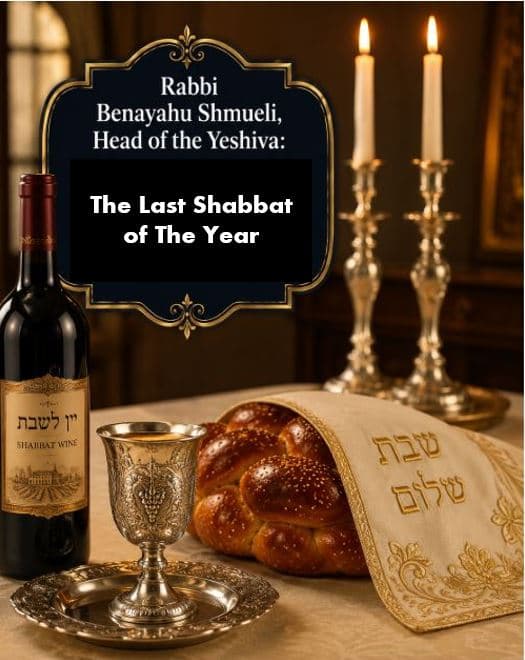
Rabbi Benayahu Shmueli, Head of the Yeshiva: The Last Shabbat of the Year

By Yeshivat Nahar Shalom Staff•September 1, 2026
sour foods on rosh hashanaevery hour on Shabbat is like 1,000 weekday hoursa special protective greenhouse during this last Shabbat of the yearthe Ben Ish Chaiburning flame in the service of Hashem

Why, for example, on Rosh Hashanah do we not eat sour foods? One of the reasons—we want a person to have a sweet year, but another reason is—when a person eats something he is not used to, something sour, he grimaces his face; he makes a... a contortion. So it is said: this... this will be the image of the entire year afterward. We don't want him to have a pose... you know, catch him in a pose, take a picture of him while he is grimacing his face, and then he will have that all year. This is by way of an allusion, right? But—it is the truth!

The last shabbat of the year

Why, for example, on Rosh Hashanah do we not eat sour foods? One of the reasons—we want a person to have a sweet year, but another reason is—when a person eats something he is not used to, something sour, he grimaces his face; he makes a... a contortion. So it is said: this... this will be the image of the entire year afterward. We don't want him to have a pose... you know, catch him in a pose, take a picture of him while he is grimacing his face, and then he will have that all year. This is by way of an allusion, right? But—it is the truth!

"You are standing today, all of you"—the way you work [on yourself], that is how you will look!  And now, everything follows the seal [the end]. This Shabbat elevates all the Shabbats [of the year]. A person needs to be in a special protective greenhouse during this Shabbat. How he guards himself, how meticulous he is with the laws of Shabbat, how he is all fire the entire Shabbat, a burning flame in the service of Hashem—and how he does this—makes a great noise in Heaven!

Why? In the month of Elul, the Ben Ish Chai writes to a person, telling him: Know that every hour is like a month. You know, every Shabbat... every hour on Shabbat is like 1,000 weekday hours. This is the Zohar, this is the Ben Ish Chai, this is the whole world. It is simple!

So imagine now in Elul, a Shabbat of Elul, and the very last Shabbat of the year—how its power is multiplied over and over again! Therefore, we must strongly utilize this Shabbat.