
Laws of Blessing the New Month
Laws of Blessing the New Month with the Halachic and Kabbalistic Reasons — Customs of Shabbat Mevarchin, the Secret of Mentioning the Molad (New Moon), Intentions (Kavannot) of the Holy Rashash, the Greatness of the Blessing of the Month, and the Words of Our Sages of Blessed Memory on Why We Do Not Bless the Month of Tishrei.
Laws of Blessing the New Month with the Halachic and Kabbalistic Reasons — Customs of Shabbat Mevarchin, the Secret of Mentioning the Molad (New Moon), Intentions (Kavannot) of the Holy Rashash, the Greatness of the Blessing of the Month, and the Words of Our Sages of Blessed Memory on Why We Do Not Bless the Month of Tishrei.
1. The Sabbath preceding Rosh Chodesh [the New Month] is called "Shabbat Mevarchin" [the Sabbath of Blessing], because they bless and announce on it when Rosh Chodesh will occur in that week. And the reason is, because on that Sabbath day all the people gather in the synagogue, and thus they hear the announcement.a
2. They are accustomed to stand during the announcement of Rosh Chodesh like the sanctification of the New Moon that was [performed] standing. And they bless it while the Torah scroll is on the bimah [reader’s platform]. And they bless the congregation and the Sages of Israel according to what was handed down to the sanctification of the New Moon by their hand. And they request that the Creator, blessed be He, will restore the crown to its former glory so that the New Moon will be sanctified by the Sages of Israel.b
3. It is proper to mention the Molad [lunar conjunction] before they announce and bless the month, and it is good to say with one's mouth the time of the Molad of the New Month on Shabbat Mevarchin at the time they announce the New Month that will occur in that week, since it is a rectification for the defect in the Brit, and if one did not know and did not mention it, it does not impede.c
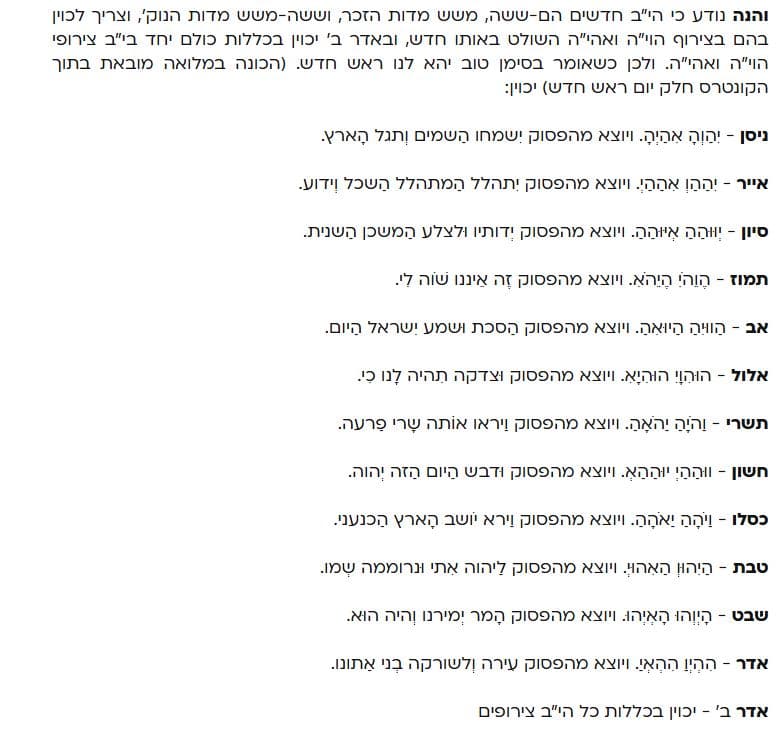
4. When saying "Mi She'asa Nissim…(He who performed miracles for our fathers)," which contain, the initial letters of 'Shin' ,'Mem' and 'Nun' one should intend in the Atbash Gematria system the holy name, 'Bet', 'Yod', 'Tet', and so when a person mentions a particular new month, they should intend the combination of the Name H-V-Y-H of that month according to its vocalization as written by the Rashash, may his merit protect us, Amen.d
5. The New Month of Tishrei is not announced, regarding which it is written, "Blow the horn on the new moon, at the covered time [alt. translation, appointed time] for our festival day".e
Notes and Comments
a. See Shibolei HaLekat (sec. 170) that the main point of the matter that they announce Rosh Chodesh is so that a person will know when Rosh Chodesh is, because on weekdays people are busy with their work and cannot always come to the synagogue and would not know when Rosh Chodesh is, and therefore they announce on the Sabbath before Rosh Chodesh. And so it was explained in Machzor Vitry (p. 173) and in the book HaKalbo (sec. 37) and see Kaf HaChaim (sec. 417 subsec. 5).
And they instituted to say this phrasing "He who performed miracles" etc., because the commandment of the New Month was the first commandment immediately when they were redeemed from Egypt; therefore, we pray for the redemption every time we fix Rosh Chodesh.
And some say the reason is because when the Temple stood, they would sanctify based on sighting, and we pray that we will gather [back], be redeemed, and return to sanctify based on sighting. And it seems to me that this is not so, for we have found that even during the time of the Tannaim after the destruction they were sanctifying based on sighting; therefore, the first reason seems to me to be the main one. Levush (O.C. sec. 421).
And what they mention (in the prayer "He who performed miracles") the redemption, because we in the future will renew like the moon, and when is this?
At the time of redemption, as it is stated (Psalms 103:5) "like an eagle, renew Your youth". Maharaz [Rabbi Aharon Halevi Tzion, nicknamed Rabbi Zelickman] (of) Binga [student of the Maharil] (p. 160. See there further).
"He who performed miracles… and redeemed" – because Israel counts based on the moon, therefore in its true renewal their redemption is dependent, when the verse (Yishayahu 30:26) will be fulfilled: "And the light of the moon shall be as the light of the sun," etc., and by merit of the sanctification of the New Month we will merit complete redemption. Therefore, they mention the redemption soon, for we have a good Redeemer (Siddur Ha-Ya'avetz, Blessing of the New Month).
b. So wrote Abudarham (Order of Rosh Chodesh) in O.C. (Vayikra Shana B' Halacha 7), and in Hasidic books it is written that the Sabbath contains the root of all days of the week, and on Shabbat Mevarchin [the Sabbath of Blessing] there is the root and power of the whole month, and that new month is blessed from the holiness of the Sabbath. And the Rabbi, author of Kedushat Levi (Parshat Mishpatim), wrote that there are in the blessing of the new month twelve blessings, which are: for goodness, for blessing, for gladness, for joy, for salvation, for consolation, for good sustenance, for livelihood, for good life, and for peace, for pardon of sin, and for forgiveness of iniquity—corresponding to the twelve tribes and corresponding to the twelve months of the year.
And so it is in the Musaf prayer, where we say, "Renew upon us this month for goodness and for blessing, etc." See in the book Sha'ar Yissachar (Ma'amar HaYerachim, Ot 8) what he wrote on this, and these are his words: Know that this corresponds to all twelve months, and in an intercalated year [leap year] corresponding to the 13th month, "for goodness" – is the month of "Nisan," which is a new month in which the redemption took place, as Israel went out of Egypt, and the redemption is called "goodness," as it is stated (Ruth 3:13) "if he will redeem you, good." "And for blessing" – is the month of "Iyar," in which the Manna descended, which is the root of blessing and abundance without constriction, as is known. "For gladness" – is the month of "Sivan," in which the Torah was given to Israel, which is called gladness, as it is written (Psalms 119:111) "for they are the gladness of my heart." "And for joy" – is the month of "Tammuz," in which the Daily Offering [Tamid] was abolished, and there will be joy when the Daily Offering returns quickly in our days. And our Rabbis expounded in Sifrei Parshat Beha'alotcha: "and on the day of your joy" – these are the Daily Offerings. "For salvation" – is the month of "Av," in which our righteous Messiah will be revealed quickly in our days, as it is brought in the Midrash Eichah that the soul of the Messiah was born on the Ninth of Av, and they said in Tanna DeBei Eliyahu (ch. 27) there is no salvation except for the days of the Messiah. "And for consolation" – is the month of "Elul," the consolation of Israel and Jerusalem will take place in the month of Elul by means of repentance, as it is written in the Gemara (Sanhedrin 97b) all the calculated dates have passed and the matter depends on nothing other than repentance. And furthermore, for consolation will also be explained as an aspect of repentance and regret, for the month of Elul is a month of repentance, hinted at in the word "consolation." "For good sustenance" – is the month of "Tishrei," as our Rabbis, of blessed memory, said (Beitzah 16a) all of a person's sustenance is decreed for him from Rosh Hashanah until Rosh Hashanah, and they expounded it from the verse "for it is a decree for Israel, an ordinance for the L-rd of Yaakov." "And for livelihood" – is the month of "Cheshvan," which is the time of division of the kingdom of Israel from the House of David, and the rectification will be in the future when the Third Temple is built in this month, so that all of the Children of Israel will be in unity, reversed from the aforementioned division; and the word Kalkalah [livelihood, Gematria 105] is the numerical value (gematria) twice B"N [52 × 2 = 104, according to Baal Haturim to Gen. 48:5 a difference of one is valid for Gematria], that each person will be B"N [a son] to the Omnipresent without quarrel. "For good life" – is the month of "Kislev," whose constellation is Sagittarius [the bow], which is the foundation (Yesod), from which go forth the sources of life; and furthermore, on account of the miracle of Chanukah, in oil which hints to wisdom, and "wisdom gives life to its possessors," and therefore it is proper to say for good life. "And for peace" – is the month of "Tevet," according to the words of the book Hakarnayim (Ma'amar 6) [One resides in peace] one who passes away in the month of Tevet, for the deceased cleaves through it to the Divine Presence (Shechinah), and we say (Berakhot 64a) one who departs from the deceased says to him "Go in peace," and from the living says to him "Go towards peace," therefore after "for good life" they say "and for peace." "For pardon of sin" – is the month of "Shevat," for the month of Shevat is in the Sephirah of Hod, and so the attribute "and He pardons sin" [from the 13 Attributes of Mercy] is also in the Sephirah of Hod, therefore Shevat hints at pardon of sin. "And for forgiveness of iniquity" – is the month of "Adar," for the month of Adar is in the Sephirah of Yesod, and behold avon [iniquity: עון] in its full spelling as such—Ayin-Vav-Nun, the gematria [of the full spelling] is 248, and what iniquity is done with 248 limbs? It is the damage of Yesod, Heaven forbid, and therefore since the month of Adar is in Yesod, it corresponds to forgiveness of iniquity. "And for atonement of rebellious sin" – is the month of "Adar II" – for in an intercalated year, Adar II is the most capable of rectifying Yesod, and therefore they say in it "and for atonement of rebellious sin," which is against rebellion – in an intentional way, to atone for those who stumble and to rectify him soon, Amen. See there further.
And indeed it is true that in the custom of the Ashkenazi communities they say in the blessing of the New Month only 11 matters: "May it be Your will, Hashem our L-rd and L-rd of our fathers, that You renew upon us this month for goodness, and for blessing, and give us: 1) long life, 2) a life of peace, 3) a life of goodness, 4) a life of blessing, 5) a life of sustenance, 6) a life of physical vigor, 7) a life in which there is fear of Heaven, and fear of sin, 8) a life in which there is no shame and humiliation, 9) a life of wealth and honor, 10) a life in which we have love of Torah and fear of Heaven, 11) a life in which Hashem will fulfill all the requests of our heart for good in the merit of the prayer of many. Amen, Selah." And behold, that there are in this prayer only 11 matters, the Gaon Rabbi Yonatan Eybeschütz, may his merit protect us, was already asked about this in his youth: why are there in the blessing of the new month only 11 matters, whereas there are 12 months in the year and consequently it should have said 12 matters in this [prayer], corresponding to the 12 months? And the Gaon, may his merit protect us, answered—who was already in his youth was a child genius—he answered: although there are 12 months in a year, nevertheless in actual practice we do not say the blessing of the month except only 11 months, for in the month of Tishrei we do not say the blessing of the month; therefore, we say only 11 expressions of matters, which correspond to the months in which we bless them. And The words of the sage [find] grace [in their hearers]. (Sefer Teshit L'Rosho).
c. Kaf HaChaim (subsec. 8) and see also in Bnei Yissaschar Part I (Ma'amar Kiddush HaChodesh sec. 8 Siman 5) who wrote that through the matter of the Molad [lunar conjunction] one fulfills the commandment to calculate the calculation of the Moladot and to understand in our understanding the birthings of the Molad. See there. And see the book of the Gaon, Rabbi Reuven Margaliot in Sefer Olalot (sec. 24) who brought a source for this matter of the blessing of the month from the Jerusalem Talmud (Ch. 5 of Sanhedrin Halacha 3) as stated there: R. Yeysse said, in all my days I did not pray Musaf if I did not know when Rosh Chodesh was. See there. And so too see in the glosses and notes on the Siddur of Rabbeinu Amram Gaon (Jerusalem 1972, Part 2) in the book Mei Chaim. See there. And see also in Shu"t Yaskil Avdi Part 7 (O.C. sec. 28 Ot 4) who wrote that there is a great reason in this to mention the Molad, in order to sweeten the severities (Gevurot) that gather strength during the diminishment of the moon after the half-month. And see in the book Karnot Tzaddik (p. 83 Ot 53) who wrote in the name of the Kabbalists, that it is good to say with one's mouth the time of the Molad of the New Month on Shabbat Mevarchin at the time they announce the New Month that will occur in that week, since it is a rectification for a defect in the Brit. See there. And see also in Shu"t R. Yehuda Miller (Part 3 sec. 113) who proved that one must also know the Molad of the month that passed, for by this it will be considered for him as a commandment of calculating the Molad by adding to it 12 hours and 793 chalakim [parts], and he will know on his own when the next Molad will be. See there.
d. Ben Ish Chai and so it is brought in holy books that when saying "He who performed miracles for our fathers," they should intend with this name, as brought in the name of the Rashash.
When saying "He who performed miracles," they should intend the initial letters Shin-Mem-Nun [שמ"ן], in A"T B"SH [a Kabbalistic letter substitution method] Bet, Yod, Tet [בי"ט]. Let it be your before you Hashem, our L-rd and L-rd of our forefathers that You will act for the sake of Your Holy Name Bet-Yod-Tet, and in the Name Chet, Bet, Vav, that You will extract every drop of seminal emission that went forth from me and from all of Israel not in a place of a commandment, and save them from the Klipah [impure forces], and return them to the Holy place, and hasten our redemption, the redemption for eternity.
Translator's note: The next section will be left in the original Hebrew, given the difficulty of putting it in English where the name of Hashem is rearranged in various combinations and pronunciations to represent the 12 months.
e. So wrote the Magen Avraham (there) [see there]. And so it is explained for this reason also in the book Haminhagim (Rabbi Yitzchak Isaac Tyrnau). [See there]. And in Mishnah Berurah in Sha'ar HaTziyun (sec. 417 subsec. 4) he brought a reason that since Rosh Chodesh Tishrei is Rosh Hashanah and everyone knows when it is, therefore there is no need to mention it beforehand. [See there]. And in the book Aruch HaShulchan (sec. 417) he wrote the reason, because it is not called Rosh Chodesh at all, but rather Rosh Hashanah. [See there]. And there are those who want to say the reason that we do not announce it, because on this day it is Rosh Hashanah and we want to confuse Satan so that he will not know when it is, and therefore we do not announce it aloud.