
Shabbat Mevarchim Month of Cheshvan (Sabbath when the month of Cheshvan is blessed)
This month is called Marcheshvan because there are no holidays in it, for in all months there is a holiday: in Kislev and Tevet there is Hanukkah, in Shevat there is Tu B'Shevat, in Adar there is Purim, etc. The only month that has no holiday in it is Cheshvan, therefore they call it Marcheshvan because it has bitterness (mar) that there is no holiday in it. And there are those who say, like "Mr. (Mar) So-and-so," Mr. Cheshvan to pay honor to it since it has no holiday.
Shabbat Mevarchim Month of Cheshvan (Sabbath when the month of Cheshvan is blessed)
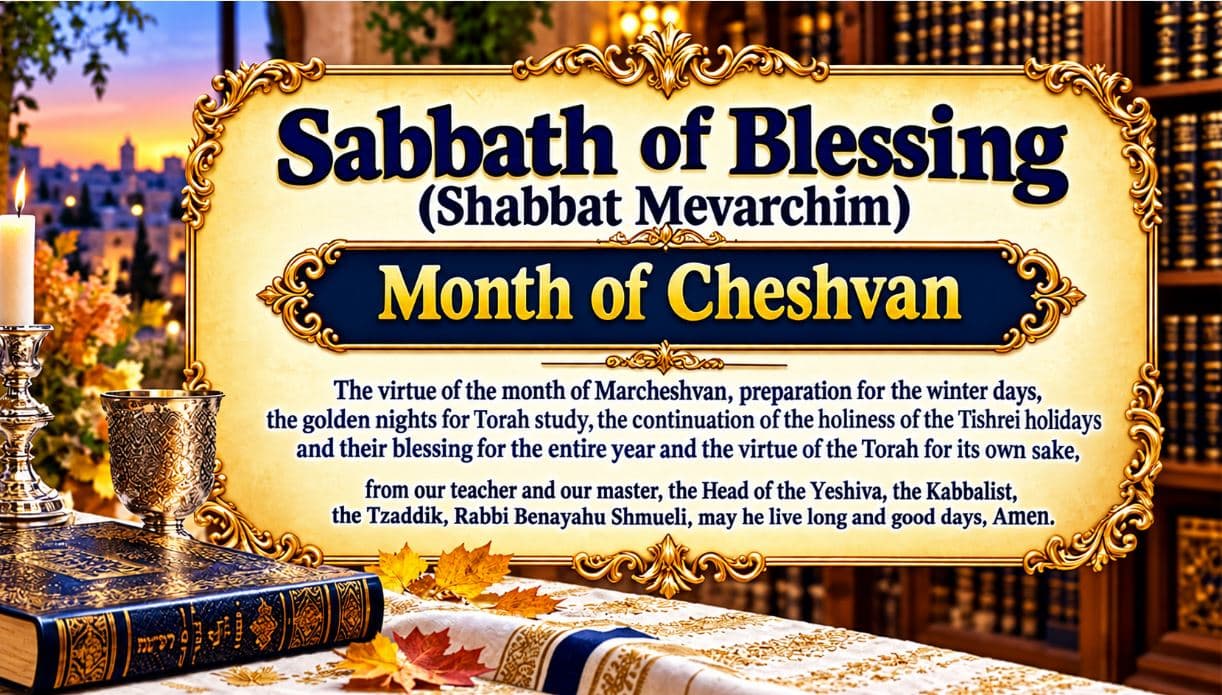
Shabbat Mevarchim Month of Cheshvan – The virtue of the month of Marcheshvan, the preparation for the winter days, the golden nights for Torah study, the continuation of the holiness of the Tishrei holidays and their blessing for the entire year, and the virtue of Torah for its own sake, by our teacher and our master, the Head of the Yeshiva, the Kabbalist, the Tzaddik, Rabbi Benayahu Shmueli, may he live long and good days, Amen.
23rd of Tishrei 5787 | Oct. 4 2026 | 13:14
We have already merited to pass Rosh Hashanah, the Ten Days of Repentance, Yom Kippur, Sukkot, and Simchat Torah, and we have also started the Torah anew once more, and now we are starting the winter season. On the eve of Rosh Chodesh Cheshvan, one needs to repent and prepare oneself for the coming month, for our good, upon us, the month of Marcheshvan. And as is known, every eve of Rosh Chodesh a person needs to return in repentance for the entire month. Although the month of Tishrei was full and abounding in Torah, in commandments, and in good deeds, nevertheless, one needs to draw them out for the entire year. And hinted at this is what the composer of prayer founded: "May it be favorable before You, Tishrei, for His people," that the month of Tishrei should be for all of Israel for the entire year. Although we had the holiday of Sukkot and a person rejoiced in it greatly, nevertheless, sometimes due to the intensity of joy, even though Yom Kippur passed over him, a person strays a bit because the Evil Inclination seduces him. And sometimes, heaven forbid, he does not properly bless, or all kinds of sins that a person treads on with his heels; therefore, one needs to repent and start the days of winter strong. Therefore, whoever can fast should fast on the eve of Rosh Chodesh, and whoever cannot should strive on the eve of Rosh Chodesh to repent and do good deeds, to walk in the ways of Hashem, and to recite the entire Psalms with seven Korotey Brit and Selichot and to make a great repentance.
This month is called Marcheshvan because there are no holidays in it, for in all months there is a holiday: in Kislev and Tevet there is Hanukkah, in Shevat there is Tu B'Shevat, in Adar there is Purim, etc. The only month that has no holiday in it is Cheshvan, therefore they call it Marcheshvan because it has bitterness (mar) that there is no holiday in it. And there are those who say, like "Mr. (Mar) So-and-so," Mr. Cheshvan to pay honor to it since it has no holiday.
And the Admor of Koshnitz explained that it is called Marcheshvan because the lips are still moving, that is to say marchishin (murmuring) - from the prayers of the Days of Awe (and) of the days of Sukkot.
Rosh Chodesh Cheshvan is always two days, because it is after Tishrei which is a full month; the first day of Rosh Chodesh is the thirtieth day of Tishrei, and the second day in which it is the first day of Cheshvan.
Cheshvan - is the second month of the year, and the eighth in the count of months starting from Nisan.
The sign (zodiac) of the month of Cheshvan is Scorpio (Akrav), Scorpio - because the world thirsts in it for rain, like a scorpion which is thirsty for water.
And it is called 'Bul' because in this month the grass in the field degrades (balah) and they mix (bollin) for livestock from the house, meaning: they mix for it fodder that is in the house. And there are those who say that it is from the word yevul (produce), that in this month the plowing and sowing begin. And there are those who say from the word mabbul (flood), that in this month a lot of rain falls.
And in the Midrash they said, because in this month the Flood began, therefore it was decreed upon it that there should be in it early rain and abundant rain.
And so, Mar Cheshvan, because in this month it is the only month in which there is no good day and there is no joy in it, and furthermore there were in it several troubles for Israel. On the 15th of the month of Cheshvan, Yerov῾am the son of Nevat devised a festival from his heart and increased the fierce wrath of Hashem upon Israel; and on the sixth or the seventh in it, the Chaldeans slaughtered the sons of Tzidkiyahu the king of Judah before his eyes, and the eyes of Tzidkiyahu they blinded, and the king of Babylon bound him in copper chains and brought him to Babylon; and in this month the Holy One, blessed be He, exacted punishment from the generation of the Flood and swept away the world and its fullness - everything that ten generations of mighty men labored over during a thousand and six hundred and fifty-six years, and only Noah remained; therefore they call this month Mar Cheshvan, a month that was bad and bitter (something bitter in Hebrew is called Mar).
Another reason, named for the water, meaning the rain that the world thirsts for and expects in this month. The meaning of 'Mar' is a drop of water, as in "Behold, the nations are like a drop (mar) from a bucket" (Yishayahu 40).
And even though there is no holiday in the month of Cheshvan, it was proper that there should be a holiday in it as in the days of King Shlomo (Solomon), when Shlomo built the Temple seven years, they completed it in this month as it is said (I Kings 6, 38): "And in the eleventh year, in the month of Bul, which is the eighth month, the house was finished in all its details and according to all its plans; so he built it seven years."
And all of Israel were expecting the dedication of the House, and Shlomo was expecting that Hashem would command him concerning its dedication – and Hashem did not command. And the Temple remained locked for eleven months, as it was, and Cheshvan lost its holiday and Tishrei gained it.
And even though Cheshvan lost its holiday, it nevertheless gained another thing due to the merit of the Temple being completed in it. For all those years from the Flood until the year the Temple was completed, the land was affected by the impression of the Flood forty days each year, from the 17th of Marcheshvan until the 27th of Kislev, and the world was in fear because of the terror of those forty days every year. Once the House was completed in the month of Cheshvan – those forty days ceased from making an impression on the world and their dread was lifted, and therefore the month is called in Scripture 'Bul', meaning, mabbul (flood) – missing 'M' (the "a" of Mabbul is a vowel sign and not a letter). And in the future, the Holy One, blessed be He, is destined to fill the month of Cheshvan for its lack, for having been deprived of a holiday.
And behold, since the building of the First Temple was completed in the month of Cheshvan and they needed to perform the dedication of the House in it, yet they waited until the month of Tishrei and in it performed the dedication of the First Temple, the Holy One, blessed be He, promised it that He will repay it in the future at the dedication of the Third Temple, which will be, with Hashem's help, in the month of Cheshvan; and behold, the dedication of the Second Temple was in the month of Kislev by the Hasmonaean Kingdom, and afterwards these three months Tishrei, Cheshvan, Kislev, in each of them there was and will be a dedication of the Temple.
And the reason that the dedication of the First Temple was delayed to the month of Tishrei is that the Holy One, blessed be He, wanted to mix the joy of the Temple with the month in which Avraham was born, etc., and since it opened in a month of appointed times and he offered sacrifices and fire descended, the Holy One, blessed be He, said, now the work is completed, etc., and regarding this it was said "How deep are Your thoughts" (Psalms 92), etc.
Golden Nights – The Time to Learn Torah for Its Own Sake
In this month, rains of blessing start to fall, water from above, and as is known, water is nothing but Torah, for Torah was compared to water, as it was said (Yishayahu 55, 1) "Ho, everyone who thirsts, come to the waters." And if so, water of Torah from above also falls. And the main point is the beginning, for now an important time begins—long nights that are called the golden nights, in which it is possible to learn a lot of Torah and to utilize the time for spiritual elevation. During the day a person is busy with his affairs, and when is he free? At night. Everyone is sleeping, and how much does he need to sleep? No more than 5 hours, as he was used to sleeping in the summer, and afterwards he has another 5 hours remaining in which he can engage in Torah.
Rabbi Tzvi Elimelech of Dynów (Dinov), who was called "Sar Beit HaZohar," said, these nights are called Chol HaMoed, like a holiday. We have nothing but Torah, and in the end everything is vanity of vanities. What will a person do with the money? "And they leave their wealth to others" (Psalms 49, 11). What did Yaakov our father ask? "And he gives me bread to eat and clothing to wear, and I return in peace to my father's house," for all the rest—everything is vanity.
Just as we began the Torah in Bereishit, for the sake of the Torah which is called "Reshit" etc. and for the sake of Israel who are called "Reshit". And as written in Scripture (Jeremiah 33, 25) "If not for My covenant by day and night, I (would) have not appointed the ordinances of heaven and earth." And as is known, "the sixth day"—the letter Hei (before the word sixth) indicated that the Holy One, blessed be He, made a condition with the creation of heaven and earth—if Israel fulfills the five books of the Torah and the sixth day of Sivan in which the Torah was given, they study Torah, they exist and endure (Hei has a Gematria of 5 and also often means, "the" when at the start of a word).
And the main thing is to study Torah for its own sake, as the Tanna said in Avot chapter 6, Mishna 1: "Rabbi Meir says, whoever engages in Torah for its own sake merits many things, and not only that, but the whole world is worth it to him. He is called beloved friend, loves the Omnipresent, loves humanity, gladdens the Omnipresent, gladdens humanity, and it clothes him in humility and fear, and fits him to be righteous, pious, upright, and faithful, and distances him from sin, and brings him near to merit, and they enjoy counsel and sound wisdom from him, as it is said 'Counsel is mine, and sound wisdom; I am understanding, power is mine.' And it gives him kingship and dominion and discernment in judgment, and the secrets of the Torah are revealed to him, and he becomes like an ever-strengthening spring and like a stream that does not cease, and he becomes modest, patient, and forgiving of insult, and it magnifies him and exalts him over all creations."
And as the Gemara says in Sukkah (49b): "'And the Torah of kindness is on her tongue'—is there a Torah of kindness and a Torah that is not of kindness? Rather, Torah for its own sake is a Torah of kindness; Torah that is not for its own sake is not a Torah of kindness."
Meaning, one who studies Torah for its own sake, then his Torah has no limit, and his Torah spreads out, and he delves deeper and deeper into it and it has no end, because it is spiritual. But Torah that is not for its own sake is physical, and anything physical has an end and a limit.
And so the Torah is a potion, if one studies for its own sake it is a potion of life, and if not, heaven forbid, a potion of death. And the explanation is that he does not know how to use the holy Torah, like a person whose doctor gave him a medicine, if he does not take the medicine according to the instructions it can, heaven forbid, cause harm.
"And Bestow Upon Us the Blessing of Your Appointed Times"
After the holidays we merited the day of Isru Chag and its explanation is based on 'Bind the festival [sacrifices] with cords up to the horns of the altar.' And its explanation: 'Bind the festival' - this is an addition to the festival of another single day, 'with cords' - is with fat meat and aged wine for the Isru Chag meal, and its virtue is like an offering before Hashem, blessed be He, as it is said, 'up to the horns of the altar', and as it is brought in the Gemara (Sukkah 45b): Reish Lakish said, whoever makes an addition to the festival, Scripture ascribes to him as if he built an altar and offered a sacrifice upon it, as it is said 'Bind the festival [sacrifices] with cords up to the horns of the altar'.
They further explained, that all these holy days of the month of Tishrei - every single day, every festival and every commandment is itself a precious pearl, and we must tie and bundle everything together, so that we do not lose the great light that we merited in these twenty-two holy days of the month of Tishrei, heaven forbid. Therefore a person needs to contemplate how to tie the holy days so that they will influence him for the entire year, so that they will accompany him when he walks in the path of Hashem, blessed be He. And this is what we pray "and bestow upon us the blessing of Your appointed times", that we will take with us the power of the holidays for the entire year.
We merited to be elevated in these important days of the month of Tishrei, the month of the strong ones, and now one must utilize all the lights and the powers mentioned above for a special escort that will give powers for the entire year.
And our Rabbi Chaim Palagi wrote, it is the custom of pious people of former times to sanctify themselves for the first twelve days after Simchat Torah, for they are preparation for all twelve months of the year, and they return to their study and learn ethical teachings and strengthening throughout the entire year, and it is a wonderful remedy so that Hashem will be with him from the beginning of the year unto the end of the year.
And so wrote the Chida zt"l - after the holiday and in the month of Cheshvan, one should strengthen himself in fear of heaven and study of Torah for its own sake, for it is the beginning of the year, and a good sign it will be for the entire year, and it will not appear that the repentance of Yom Kippur was only from the lips outward, but rather from inwardness, and his mouth and his heart are equal, and it is a good sign for the entire year.
And in books of Hasidut it is brought to explain in the liturgical poem of Azamer B'Shvachin, the words "May it be favorable before Tishrei for His people", the intention in this is: May it be the will that the aspect of the month of Tishrei in which we connected to the Holy One, blessed be He, in holy service will rest upon us, that the aspect of the month of Tishrei will rest and influence us throughout the entire year.
And the Sages said that Shabbat Bereshit is the time when one needs to "pack the merchandise" of the month of Tishrei, and that is because on Rosh Hashanah we acquire the yoke of the Kingdom of Heaven, and on Yom Kippur we acquire repentance, and on Sukkot we acquire joy, and now we pack the merchandise so that it arrives throughout the year at the correct place.
Water Is Nothing But Torah
We are entering the winter period; the month of Cheshvan is the eighth month, in which the main engagement is in the holy Torah, and in it fall rains of blessing—water from above, and water is nothing but Torah, for the Torah is compared to water; and may Hashem grant that there fall upon all the house of Israel water of Torah from heaven, and the Holy One, blessed be He, will enlighten our eyes in His Torah.
When rains fall there is great joy, for the Holy One, blessed be He, forgives the sins of Israel, as written in the Gemara (Taanit page 7a). However, we have seen that rains are withheld due to the sin of neglect of Torah, and so they depend on our actions. And the Maggid of Radomsk ztvk"l brought a parable about a house in which a fire broke out, etc., and people want to save the residents inside it, and there is a bolt and a bar inside that cannot be opened from the outside. These shout from inside and those from outside—so too the Holy One, blessed be He, shouts to us: "Open for Me" etc., and we shout: "Turn us back, Hashem, to You," and the Holy One, blessed be He, says: "The key is on your side."
Three joyful sounds—the sound of rains from outside, the sound of coins from inside, the sound of Torah whether inside or outside.
Learning Mussar Lessons From the Times of Day and Night
Writes our Rabbi Yosef Chaim A"H: These nights in which we start from Bereshit are long nights—fifteen and sixteen hours—and the day is short, and in summer it is the opposite. In winter, the night borrows from the day, and in summer the day repays and takes back what it lent to the night. And why did the Holy One, blessed be He, do so, that He made twelve hours, twelve hours—a set night and day? And the Rabbi explains that many things are learned from this: First thing learned—that a person should wake up at night to study, for in summer the night is short and he sleeps six hours, and winter arrives and the night is fifteen hours long—what will he do with it? Rather, let him get up and go study! You have two, three, four hours—it is possible to study. And if the Holy One, blessed be He, had made the day and the night equal, from where would a person think that the night was created in order to study? But when the night changes from summer to winter, the intention is that one needs to study.
Another thing learned from this: If a person accidentally could not maintain his fixed study session, because he had some business, or he had to go to a doctor with his children or arrange some matter, let him not say—these hours went to loss. Rather, just as if I study every evening two hours, and this evening I did not go, then tomorrow I will make this up, and from where will he learn it? From the night and the day—just as the night collects from the day in winter and repays it in summer, so too a person needs to do so: if he missed some hours in the day, he shall make them up on the second night, and thereby fill what he needs to do.