
Parshat Re’eh part 1
There are people who, due to an abundance of goodness, seek to rebel, and there are people who the opposite on account of troubles. To both of them, the Torah says: See, I set before you "today" a blessing and a curse, but tomorrow it is possible that the opposite will come upon you.
"See, I set before you today a blessing and a curse" (Deuteronomy 11:26)
There are people who, due to an abundance of goodness, seek to rebel, and there are people who the opposite on account of troubles. To both of them, the Torah says: See, I set before you "today" a blessing and a curse, but tomorrow it is possible that the opposite will come upon you.
This verse comes to teach us an answer to two types of bad thoughts that arise in people's hearts. Sometimes a person reflects on his condition and sees that he is organized, Baruch Hashem; behold, he has a decent apartment, sons and daughters, a good wife, wealth, and honor. Therefore, a flawed thought arises in his heart that he can Heaven forbit unload a bit of a yoke from upon himself, in the aspect of "And Yeshurun grew fat and kicked" (Deuteronomy 32:15). This is because he thinks that even if he transgresses Hashem's commandments, and they punish him from Heaven, it is impossible to take from him all the abundance in his possession, for he has many investments and many assets, and even if Heaven forbid he falls in some business, he will still remain a big wealthy man in his other businesses.
In contrast to this, there is a person who is in the greatest troubles, to the point that he thinks there is no harder situation than this, and despairs and thinks that nothing in the world will help him, and everything he does will not succeed in his fortune.
And upon this comes the verse and says: Look and observe, I set before you today a blessing—indeed you have a blessing today, but all this is only today, and tomorrow it is impossible to know what a day will bring, for the Holy One, blessed be He, can take from a person all his property, and make him poor in one moment, or that other problems will come upon him Heaven forbid in his house with his wife, with his children, etc. And it can also be that the Holy One, blessed be He, will leave all the property and the good in the world to his heirs, and will take the person himself from all the abundance and the good He gave him. Therefore, know that "See, I set before you today a blessing"—today I set before you, but tomorrow there can Heaven forbid be a curse.
And so conversely, as stated, sometimes a person sees that he has very harsh troubles, and thinks that he no longer has a remedy, and despairs Heaven forbid. Therefore, the verse says to him: See, I set before you today a curse, but tomorrow with the help of Hashem, blessed be He, you will have a blessing, for tomorrow there is already another fortune, a different blessing, and the Holy One, blessed be He, can flip everything in a single moment.
Every person should look and reflect in his mind that he has nothing in the world except the day he stands in
And thus explained our Master Rabbi Yosef Chaim, may the memory of the righteous and holy be for a blessing, in his book Od Yosef Chai (Drashas for Re'eh s.v. "And in another manner") and this is his wording: With the help of Heaven, they said: "See, I set before you today," good advice it sounds to him, that every person should look and reflect in his mind that he has nothing in the world except the day he stands in. And this perspective benefits him, whether in a blessing—meaning to say, at a time when he has wealth and much goodness, when the evil inclination draws his heart to great pride and haughtiness of head due to an abundance of goodness, in the manner of "And Yeshurun grew fat and kicked," then this perspective benefits him that he will not kick and will not act wickedly, since he sees in his mind that he has nothing in the world except that day he stands in. For it is possible that at night his soul will depart and will not return to him anymore, and a dead carcass will remain and be brought to burial. And whether in a curse—when he has pain and afflictions, whether in tight livelihood or in illnesses of his body, and if he reflects on this, then he will be quiet and rest from the pain, and as the wise man said "Do not grieve about tomorrow" [for who knows what a day will bring], lest tomorrow he is not, and you turn out grieving over a world that is not yours. And regarding this he said, "See"—look in your thought and in your intellect that "I set before you today"—meaning to say "this day" that you stand in alone. And see, this intellectual perspective is good and necessary for you, both in a time when there is "blessing" and goodness in it, and in a time of "curse."
This Too Shall Pass
It is told about a wise father, who at the time of his old age called his son to come to him, for he had prepared his will for after one hundred and twenty. When the son arrived, his father gave him a signet ring engraved with pen-stylus: "This too shall pass." To the wonderment of his son, the father explained his statement: Know, my son, that if you see that the Holy One, blessed be He, has bestowed upon you abundance and blessing, do not be sure that this abundance will remain for you forever, and thus you might throw off from yourself the yoke of the Kingdom of Heaven, Heaven forbid; rather, always be prepared in His service, blessed be He, for it is possible that all this abundance and this goodness "too shall pass" from you. And so conversely, if you see that many and strange troubles have come upon you, do not despair and say I have no remedy, Heaven forbid, but rather "this too shall pass."
Even the King and the Snake...
Says the Mishnah (Berakhot 30b): Even if the king greets him, he shall not return his greeting, and even if a snake is wound around his heel, he shall not interrupt. The Admor Rabbi Shlomo HaKohen of Radomsk, may the memory of the righteous and holy be for a blessing, explained [this] in the way of Hasidism: Sometimes a person sees that he rises to very high levels, to the point that the Supreme King greets him, and he merits to reach high spiritual attainments. And this is "Even the king"—he is the King of the universe—"greets him, he shall not return his greeting," meaning despite all the levels that the King of the universe raised him to, he should know that he needs to be careful not to interrupt prayer to the Creator of the universe, and not interrupt being attached to the Holy One, blessed be He, at every moment, for he does not know what will be with him, and the moment a person leaves the Holy One, blessed be He, even for a moment, he can Heaven forbid fall and lose all his level that he merited until now.
And so on the other hand, if Heaven forbid a person sees that the husks (kelipot) have clothed themselves upon him, and he is already, as if by nature, inside severe sins, and is entirely immersed in the lusts of this world to the point that the snake has swallowed him from his head to his heel, and therefore thinks that no prayer will help him because he cannot exit his situation—about this the Tanna says to him: "Even if a snake is wound around his heel," meaning even if the snake—which is the evil inclination—has already swallowed him entirely from his head to his heel, nevertheless "he shall not interrupt," meaning he shall not stop praying to the Holy One, blessed be He, and be saved, as our Rabbis said (Berakhot 10a): Even if a sharp sword rests upon a person's neck, a person should not despair of mercy.
And so, the Gemara (there) relates about King Chizkiyahu, as it is written (2 Kings 20:1): "In those days Chizkiyahu became sick unto death, and Yishayahu the son of Amotz the prophet came to him and said to him: Thus said the L-rd of Hosts, set your house in order, for you shall die and not live, etc." What is "for you shall die and not live"? "You shall die"—in this world, "and not live"—in the World to Come. Said [Chizkiyahu] to [Yishayahu]: Why all this? [For what reason do I deserve such a severe punishment?] He said to him: Because you did not engage in procreation [that you did not marry a woman]. He said to him: Because it was shown to me by Divine Inspiration that bad children would emerge from me [children who are not proper]. He said to him: What do you have to do with the secrets of the Merciful One? [What do you have to do with the hidden things of the Holy One, blessed be He?] What you were commanded to do, you ought to do [what you were commanded, meaning to marry a woman], and what is pleasing before the Holy One, blessed be He, let Him do [and the Holy One, blessed be He, will do what is good before Him, and this is not given to your choice]. He said to him: Now, give me your daughter [give me your daughter for a wife], perhaps my merit together with your merit will cause righteous children to be born to me. He said to him: Already a decree has been decreed upon you. He said to him: Son of Amotz, finish your prophecy and leave! Thus, I have received from my father's house: Even if a sharp sword rests upon a person's neck, a person should not withhold himself from mercy.
Everything is from Above and Man Can Act and Do Nothing by Himself
The holy Rabbi, the "Yitav Lev", ZY"A, explained the verse in the Torah portion: "See, I set before you today," that behold, the cantillation mark (ta'am) above the word Re'eh ("See") is a Revia, which is marked above the word, and in the spelling of Anochi ("I"), the cantillation mark is a Tevir, whose place is below the word. And it hinted to us that in all occurrences that happen to him, a person should gaze and reflect upon the cantillation mark (ta'am / reason) that is Above—that everything comes from Him, and He is the Cause of all causes and the Reason for all reasons. Then the ego (anochi'ut) and his pride will tevir (break—in Aramaic), his pride will break completely and he will remain pure and clean (brought in Moshi'an Shel Yisrael, Vol. 2, p. 361).
Behold, the genius and holy Rabbi, the "Chafetz Chaim", ZY"A, allegorized his parable (Parables of the Chafetz Chaim, p. 74, to his disciple R' D. Zaretsky): Once a villager happened upon a train station, and behold, he sees a man standing next to the train with a trumpet in his mouth, and he saw a wonder—when this man blasts once, all the crowd hastens to board the train; after a few moments this one continues to blast a second time, and then even the dawdling ones hurry while they still have breath in them to board the train; after that, this one blasts a third time and the train begins its journey. The villager was amazed at the power of this man, and straightaway approached him and said to him flatteringly: "It is a great honor for me to know the leader and manager of the trains, a man by whose word everything is determined." The man filled his mouth with laughter, saying: "You made a big mistake, my son! I am nothing but a minor employee, fulfilling all the instructions of the manager sitting up there in a fancy place, dressed in suit garments; he is, the owner who earns a great fortune from every train journey, by whose word everything is determined, and he determines all the laws and times of the journeys. I am nothing but a simple agent."
Also, if we reflect on how we differ from that foolish "villager", when we invest in connections with activist So-and-So and with generous person Such-and-Such, [thinking] that these rule the world, and that these can cause a person to be "glad and merry of heart due to all..." to the extent that it is possible to say there is hidden heresy in this... For everything depends on the will of Hashem, blessed be He, and not on the will of a man, whoever he may be, as it is said (Psalms 146:3-5): "Do not trust in nobles, in a son of man who has no salvation... Happy is he whose help is the Almighty of Yaakov, whose hope is in Hashem his L-rd."
One Who Does the "Will" of the Creator Will Be as a "Pipe" to Influence the Multitudes
The Gaon Chida wrote, in Nachal Kedumim (beginning of our Torah portion) [on] "See, I set before you today a blessing": It is possible that there is a hint in the initial letters of the words that add up in Gematria to 288, for our whole intention in Torah and commandments is to clarify the 288 holy sparks, and "and this is the blessing"—that through raising the 288 sparks, we merit to rectify the worlds and unify everything.
Further continues (there) Rabbeinu, the Chida: Why "See" (Re'eh) in the singular form, and after that "before you" (Lifneichem) in the plural form? Rather, every single individual can rectify, and he will be the pipe to influence the multitudes. Just as our elder, Rabbi Chesed LeAvraham, of blessed memory, elaborated: Look and see that he who does the will of the Creator, the word "will" being composed of 'Reish', 'Tzadi', 'Vav', 'Nun' shares the same 4 letters as the word Tzinor, (pipe")—he will be like a pipe to influence through his hand a frequent abundance of heavenly blessings to all Israel.
Before Every Deed That We Do, We Must Remember That It Impacts All of Israel, for Good or for Bad
An explanation is needed why the verse opened in the singular form—"See" (Re'eh)—and concluded in the plural form—"I set before you" (Lifneichem)? And behold, the commentators explained the matter according to the words of the Gemara in Tractate Kiddushin (page 40a): A person should always view himself as if he is half guilty and half innocent... If he performed one commandment, fortunate is he, for he tilted himself and the entire world to the scale of merit. If he committed one transgression, woe to him, for he tilted himself and the entire world to the scale of guilt. Up to here [the Gemara]. And this is what is said: "See"—you, the individual, "I set before you [plural] a blessing and a curse"—before every deed that you do, remember that this action impacts all of Israel; if it is a commandment, behold you fulfill it for all of Israel and bestow a blessing upon them, and if it is a transgression, you bestow upon them the opposite, Heaven forbid.
And one should not think, "Are we not children of the Holy One, blessed be He, as it is said (Deuteronomy 14:1), 'You are children to Hashem your L-rd? How then do we understand the possibility that the Holy One, blessed be He, will place a curse upon the nation of Israel, His children, Heaven forbid?" Rather, certainly the Holy One, blessed be He, leads the world with the attribute of kindness and with the attribute of mercy, and the question is in which path the person chooses. A person who fulfills commandments empowers the attribute of kindness upon himself, whereas one who commits transgressions empowers the attribute of judgment upon himself. Thus, it turns out that he draws upon himself the opposite of the blessing. A hint to the matter is in the word "today" (HaYom), as it is said (here) "I set before you today," meaning like the example of the sun that shines in the day. If we take an egg and place it in the sun, behold it will harden from the heat of the sun. In contrast to this, if we take ice and place it in the sun, it will thaw and melt. Here we have that the sun performs the same action, and yet the result is opposite, sometimes hardening and sometimes melting. So too in the allegory, the Holy One, blessed be He, leads His world with kindness, and man in his choice decides whether to draw upon himself the kindnesses of Hashem or not. One who fulfills commandments draws kindnesses upon himself, and in contrast to him, one who commits transgressions draws upon himself the attribute of judgment. And if so, Heaven forbid, to claim that the Holy One, blessed be He, curses Israel.
Wonderful Grammatical Nuances in the Wording of the Verse
It is brought in the book Peninim MiShulchan HaGra on the Torah, why did the scripture say "gives" ("noten"—present tense) and not "gave" (natatti—past tense)? And he explained, that if it said "gave", I would think that the choice given to man to go in the good path is specifically at the beginning of choice, but if he already chose for himself the bad path, even if afterward he clarifies for himself the good path, he no longer has a remedy. Therefore, the scripture said "gives" ("noten") in the present tense, meaning that in all your days you have a choice to choose the good path, even until the day of death.
And if perhaps a person will say, what remedy do I have if I was wicked until now, and what shall I do with the transgressions I committed, and surely, I have no remedy? Therefore, scripture said "today", for a penitent (ba'al teshuva) is like a child born "today", and therefore it is enough that he does repentance and goes in the good path from now on.
And if further a person will say, what shall I do with the evil inclination that forces me? Therefore, scripture said "I" (Anochi), and the meaning is, "I" will be with you, and do not fear the inclination, as the statement of Sage, of blessed memory (Sukkah 52b), a person's inclination overwhelms him every day and seeks to kill him, as it is said (Psalms 37:32) "The wicked watches for the righteous and seeks to kill him", and were it not that the Holy One, blessed be He, helps him, he could not overcome it.
And if a person will further say, perhaps it is not a good path, [but rather] it is the way that appeases me with all kinds of appeasements like the way of sellers of merchandise who appease buyers with all kinds of tricks when the merchandise is bad? Therefore, scripture said "before you" (lifneichem), meaning, this matter is before you, I am not forcing you, therefore I did not say to you, but only before you.
And whereas a person will further say, that all this is said when there are righteous people in the world, but I live in a foreign land and there are no righteous people with me, how shall I clarify for myself the good path, and what am I and what is my life? For this scripture said "See" (Re'eh) in the singular form, and did not say "See" (Re'u) in the plural form, meaning to say, look for yourself and do not pay attention to the world.
Even the Curse is a Blessing, for He Overcomes His Inclination and Ascends Very High Spiritually and Merits Lofty Levels
Wrote the great Gaon, Morenu HaRav Eliyahu Shreim, may the memory of the righteous and holy be for a blessing, in his book Musar Chachamim on the verse "See, I set before you today a blessing and a curse": Sometimes one needs to know that even in a place of a severe curse it is possible to acquire the life of the World to Come. Meaning, the curse too can become a blessing, as if the Holy One, blessed be He, placed him in a difficult place with bad and sinful people, a blessing can emerge for him from there, when he overcomes his inclination and ascends very high spiritually and merits lofty levels.
And I heard that this is the matter of the ladder shown to Yaakov our father, when he went to Haran. Because when Yaakov our father went to the house of Lavan, he grieved very much and worried that he would not be able to engage there in Torah and service. For until now he sat in the house of Yitzchak his father and in the house of Shem and Eiver, and engaged only in Torah and service, and now he was going to the house of Lavan the wicked, a place of impurity and husks (kelipot) of idolaters—and how would he be able to acquire Torah and commandments there?
For this, they showed him from Heaven so that he would not grieve, that a Jewish man is like a ladder set on the earth and its top reaches to the heavens (Genesis 28:12). Meaning to say, even though he is placed in an evil place, in a place of impurity, "on the earth," in physicality, nevertheless he can ascend on the steps of levels until his head reaches to the heavens. For this, when Yaakov awoke from his sleep, he said (Genesis 28:16): "Surely Hashem is in this place and I knew it not." Meaning to say: "I" (Anochi)—I thought and always supposed that a person cannot ascend on the steps of levels unless he stands in a holy place like my father's house, or like the house of Shem and Eiver; however, he can ascend to a high level even in an evil place like the house of Lavan—this "I knew it not" (Anochi lo yada'ti). Up to here [his words].
In connection to attaining high levels even in very low places, it is told about the secretary of the Chevra Kadisha (burial society), that on Friday afternoon the phone rang at the secretarial office; the secretary lifted the receiver, and on the line were family members who requested to arrange a funeral for the head of their family, and in their desire to perform the funeral immediately right before Shabbat, but after it was explained to them that time was very short and it was impossible to do so, the funeral was held on Saturday night. Due to various delays, the funeral was held late at night. On the way to the burial on the Mount of Olives, the Chevra Kadisha men noticed that they were missing a tenth man to complete a quorum (minyan); therefore, they decided to stop next to a study hall (beit midrash) that was on their path, and ask a person to be ready to join them for the funeral. And behold, in the study hall they found a certain man who was preparing a lesson to deliver the next day to his students. Indeed, at first the man hesitated, but again closed his books and ran to fulfill the commandment that his Creator summoned to him. After the burial, on the Mount of Olives, before the Chevra Kadisha men dispersed, one of them remembered that the deceased requested very much to sing the song Bar Yochai at the time of burial. However, there was no one present who remembered the song fluently by heart. Suddenly the man who completed the quorum remembered that in his pocket he had the required song, and began to sing Bar Yochai. They finished the song, and descended from the mountain. The tenth man for the quorum was moved all through with wonder upon wonder, and said: Hear please, my masters, listen and see wonders of wonders, how the Holy One, blessed be He, orchestrated that the will of this deceased person would be fulfilled, that they would sing the liturgical poem Bar Yochai after his burial. My usual way was to pray the early Mincha in a nearby synagogue each Shabbat. And for some reason I prolonged the Shabbat meal, and I went to another synagogue to pray Mincha. When we arrived near the synagogue, my son pointed to the ground and showed me that rolling on the floor was a page requiring genizah (sacred disposal). I lifted the page; it was a page printed with the song Bar Yochai upon it, therefore I kissed it and put it in my pocket until I would bring it to genizah. After the prayer I forgot about it, and the page remained in my pocket, and it is obvious that this occurred only to fulfill the desire of the deceased. And furthermore, the Rabbi continued to tell, another wonder occurred: For usually I prepare the lesson for my students in my home's living room, and for some reason today the noise of the children in my home increased, and therefore I decided to go out to the synagogue in order to prepare the lesson. And now I understand what and why it was upon me to leave the house and in my pocket stored the song Bar Yochai, and why they orchestrated from Heaven that I would learn in the synagogue, this so that the Chevra Kadisha man could meet me. This man investigated to see who the deceased man was, that these things happened with him. It turned out that he was a completely simple person, except that in his days he did not miss the pilgrimage to Meron on Lag BaOmer, and even visited the tomb additional times during the year. And beyond this, every Friday night he was singing with great enthusiasm the song Bar Yochai at his table, and it seems there was in his soul a spark of the Tanna Rabbi Shimon bar Yochai, and therefore they orchestrated from Heaven that his will would be done, and over his bed they would say the hymn Bar Yochai in a wondrous way.
"See", the Commandments of "I", and Know That Before You is "Blessing"
"See, I", to be explained, "See", meaning to say if a person "sees" and sets before his eyes the "I" am Hashem your L-rd, that is to say, he fulfills the first law of the Shulchan Aruch, "I have set Hashem always before me", know faithfully that "before him" will come "blessing".
Either "Blessing" or "Curse"—There is No Middle Ground
Among the nations there is a nation that rules over other nations, and there is a nation lowest of all, and there is a nation found in an intermediate state, on the one hand not ruling over others, and on the other hand also not ruled over. However, with the nation of Israel there is no intermediate state, but rather either they walk in the path of Hashem and ascend higher and higher and rule over the entire world, and if not, Heaven forbid, they descend lower and lower and are ruled by others. The middle ground—that they sit in tranquility, not ruling over others and others not ruling over them—does not exist for the nation of Israel. Therefore, the verse said "See, I set before you today a blessing and a curse": either a blessing that ascends over all, or a curse that descends below all, and an intermediate state is not found.
The Holy One, Blessed Be He, Cannot Pay Us the Reward for Commandments in This World, Due to Its Greatness and Immensity
Every day we say in prayer, "These are the things whose fruits a person eats in this world while the principal remains for him in the World to Come"—meaning, in this world they pay a person only the "fruits" of his good deeds, but the main reward, which is the "principal," is in the World to Come, for there is no strength to give a person reward for his deeds in this world, because the reward is very great and spiritual, such that in this world there is no possibility to pay it, therefore a person receives in this world only a little from the fruits due to him, and this is called "blessing"—meaning to say, what the business earns in good profits above the principal, this is a blessing from Heaven. And therefore, in commandments and good deeds there is "blessing" and there is "principal"; the principal is only in the World to Come, and this is what is said here, "See, I set before you today"—meaning here in this world, "blessing," which is the fruits "today," but the principal remains for the World to Come, as the verse continues, "and a curse," which is in initial letters of the phrase "and the principal remains for him in the World to Come".
And explained Rabbi Henoch of Alexander, for there are two types of "today": one is the today of blessing, and the second is of curse. The today of blessing says (Eruvin 22b), "'today to do them' and tomorrow to receive their reward." Whereas the today of curse says (Isaiah 22:13), "Eat and drink, for tomorrow we die"—meaning eat "today" for tomorrow you die. Behold, every person has a choice to choose between the today of good to the today of evil; however, our Torah suggests and also commands us (Deuteronomy 30:19), "And you shall choose life so that you may live."
In this way they explained in the Gemara (Eruvin 22b) the verse (Deuteronomy 7:11), "Which I command you today to do them"—today to do them, and tomorrow to receive their reward. For this world is the world of action, and the World to Come is the world of "tomorrow to receive their reward," the world of recompense.
A parable: To what is the matter comparable? To a merchant who traveled for his business in a wagon, and since the journey was long, the wagon driver requested his pay already in the middle of the journey. The merchant said to him: If you request the pay for the journey, I will not give it to you until we reach our destination. But if you request payment for travel expenses, such as for the purchase of horse food or for a certain repair, I will give you already now.
By contrast, so too with the reward for commandments is the matter, for the true reward for our action in the world of action we will receive only in the Future to Come; however, grant payments to fulfill the Torah already now we receive, and this is what is said, "The blessing, that you shall obey," and Rashi explained: in order that you shall obey.
The Holy One, Blessed Be He, Asks of Us That We Choose the Good Portion, Which Is the Blessing
He wrote in the book Likkutei MiPardes (Sharim, beginning of our Torah portion in the section of Pshat) on the words in the verse "See, I": One who casts lots with his fellow [to decide] which portion each of them will receive, his way is to hide the good portion so that his fellow will not take it; but Hashem, blessed be He, says to each and every one, "See, I set before you," and the portions are "a blessing and a curse"—not only does Hashem not hide the good portion, but He even points to it for us and says "See," and "you shall choose life."
Further hinted the Torah, "a blessing and a curse the blessing"—behold, the Torah placed here next to the word "curse" two guardians: "blessing" on the right side, and "blessing" on the left side, and in this the Torah returned to explain, how does it give "before you" two opposites in one subject? For this it said nearby, "the blessing that you shall obey" [in a language of certainty that thus they will do], whereas regarding the curse it said nearby, "and the curse if you will not obey" [in a language of doubt], for all Israel are in the presumption of being proper and certainly will obey to [receive] blessing, whereas the curse is in doubt.
According to his approach it is possible to add, [as] is said further on (Deuteronomy 30:19), "life and death I have set before you, the blessing and the curse." Lest Israel say, since the Omnipresent placed two paths before us, a path of life and a path of death, shall we walk in whichever we desire? Scripture therefore adds: "And you shall choose life so that you may live, you and your seed."
Parable: To what is the matter comparable? To one who was sitting at a crossroads, and there were two paths before him—one whose beginning is level ground and its end is thorns, and one whose beginning is thorns and its end is level ground. And he was informing passersby and saying to them: You see this path whose beginning is level ground, know that only two or three steps do you walk on level ground, but all its continuation is thorns. On the other hand, you see the path of thorns, only two or three initial steps do you walk in thorns, and after that you come out onto level ground. Thus Moshe said to Israel: You see the wicked who succeed in this world, know that only about two or three days do they succeed and their end is to be pushed away at last, as it is said (Proverbs 24:20), "For there will be no future for the evil one," and it says (Ecclesiastes 4:1), "and behold the tears of the oppressed and they have no comforter," and it says (Proverbs 4:19), "The way of the wicked is as darkness, they know not at what they stumble." And you see righteous people who grieve in this world, [only] as two or three days do they grieve, and their end is to rejoice at last, and so it is written (Deuteronomy 8:16), "to do you good at your end." And it is written (Yirmiyahu 29:11), "For I know the thoughts." And further it is written (Proverbs 4:18), "And the path of the righteous is as the light of dawn."
Moshe Said to Them "See, I"—Look at Me, Who Truly Loves You and Cares for You (As You Know)
Our Teacher, the Great Gaon, Maran Head of Yeshivat Porat Yosef, Morenu HaRav Yehuda Tzadka, ZTvK"L, wrote in his book Kol Yehuda (Parashat Bechukotai, p. 204) to question regarding the verse "See, I", what place is there to say "See" when it should have said "Hear"? See in Ohr HaChaim HaKadosh for nice explanations. And it seems to me with Heaven's help, that the reason he needed to say "See, I", is because Moshe feared that the people of Israel would wonder about him, how he dared to curse them so harshly. Therefore, he said to them, look who is speaking to you, "See, I"—meaning "see" "I", for you know me, how much I love you, how much I devoted my soul for you, and if I curse, this is not a curse, but rather this reality, and the curse will be if you do not obey.
A parable: To what is the matter comparable? To a mother who says to her small son, "Be careful, my son, not to touch the electrical wires, and if you touch, you will die." The son wondered at his mother's cruelty and said, "What did I sin that you curse me so much?" His mother said to him, "See, my son, who is speaking with you—Mom, as it is known to you how much I love you; know, my son, this is not a curse as a punishment, but only this reality." Therefore, he said, "See, I".
In the World of Truth, Difficulties Do Not Exist at All
And even if a person has difficulties and lack of understanding regarding the matter of afflictions that come upon him and in the order of Hashem's conduct, blessed be He, with him—for he walks in the path of Hashem and learns Torah and fulfills commandments, and does not understand why afflictions come upon him—nevertheless he should believe with a whole heart that since he fulfills commandments and meditates on Torah, the blessing is with him, and all questions regarding the matters of this world are not questions.
A story (brought in Yalkut Me'am Lo'ez, Shoftim p. 81) that there was a student of the Ramban, of blessed memory, who fell ill, and the Ramban came to visit him. Since he saw that his end was near, and he was going to his eternal home, he said to him: Hear now, my son, what I shall command you. Know that in the Upper World there is an Upper Palace, and there are thrones for judgment and the Divine Presence (Shechinah) stands in their assembly. Here is an amulet for you, and know that as soon as you arrive, all the gates of the palaces in the firmament will open for you, until you reach this Upper Palace, and there ask several immense questions that I have concerning all of Israel. He gave him the questions in writing, and requested that after his death he come to him in a dream and tell him the answers that he hears there.
The student passed away to his eternal home. And it was on a certain day and the Ramban was sitting next to his window and studying Torah, and behold, the image of his student appeared before his eyes. The student said to him: Know, our master, that in every place I arrived and showed the amulet, the gates opened before me, and they gave me permission to ascend higher and higher up to this Palace that you told me about. However, when I wanted to ask there the difficulties that my master and teacher prepared for me, I immediately saw that all the difficulties do not exist in the World of Truth, for there it is a world of pure truth (alma d'kshot) and everything is in accordance to righteousness and judgment.
How the Chazon Ish Explained the Disaster of the Holocaust
In the book Levush Yosef (Yasher, of our Torah portion, p. 67) it brings that when they asked Maran the Chazon Ish: How is it possible that the Holy One, blessed be He, He who is the Father of mercy, decreed the Holocaust upon the people of Israel, [and that they] suffered so much, beyond imagination? He answered them: One who does not understand tailoring matters, when he sees that the tailor cuts the cloth, he thinks that he is cruel, that he is ruining the cloth. But one who understands tailoring knows that actually the cutting of the cloth is the rectification, for through these cuts he sews a beautiful garment. So too we do not have it in our hands to understand the account of the Creator of the world.
In the World to Come We Will Regret That We Were Not Privileged to More Afflictions, [for] the Reward for Them Is Immense
And certainly, when a person sees the giving of reward in the World to Come, he will be grieved and say, what a pity that I was not afflicted even more in the passing world.
We will illustrate this with a story of a Jew who was renting quarters from one of the noblemen. The minister in charge of collecting rent for that nobleman was a gentiles' minister, a hater of Israel. Our Jewish friend was careful to pay the rent on time, for he was a kosher and decent Jew. However, once when the payment day arrived, the Jew said to the minister, "This time I have not obtained money; please give me a few hours until I procure a loan." The minister flew into a rage at him and said to him, "If you do not pay now the money, you will receive lashing," and so it was, he beat him with vigorous blows. What did the Jew do? He approached crying to the nobleman, and recounted the story to him. The nobleman said to the minister in charge, "For every blow that you gave him, you must give him one gold coin." That Jew went to his house sad. His wife asked him, "Why are you sad?" He said to her, "I am in grief over not receiving more lashings from him, for if I had received more lashings, I would have become much wealthier."
So it is in the World to Come, for every pain that comes to a person here in this world, even for the smallest pain, there they receive much reward. And when we see the immense reward, we will be filled with great grief that we were not privileged to more afflictions here in this world.
To Share in the Pain of His Nation
There is a different relationship regarding pain and afflictions that a person brings as it were upon himself; as it is known that during the Second World War, that the Chazon Ish did not sleep at all on a bed, even though it is known he was very, very weak in his nature, to the point that even for his Torah learning he was learning lying down, but he said that when there is pain for the nation of Israel, we must share the burden in that pain. And so, it is told about Maran the Chafetz Chaim, that during the First World War, for four years he did not sleep at all on a bed.
"The Blessing, That You Shall Obey" (11:27)
"The blessing that you shall obey" — [the] final letters [spell] Torah, for this is the true and great blessing.
Wrote the Baal HaTurim (here) "the blessing that you shall obey", final letters [form] Torah, for when a person studies Torah, and endeavors in it and fulfills it, this is his true and great blessing, "that you shall obey", for anyone who obeys that which the Torah commands us, he has a great blessing, and there is not upon him, Heaven forbid, curse and afflictions.
"The Blessing, That You Shall Obey, Etc. And the Curse If You Will Not Obey" (11:27–28)
In the Merit of "That You Shall Obey" Which Hints to the Recitation of Shema, You Will Merit Blessing
One of the great pieces of advice to be saved from {harm in} war is according to what is said in Parshat Shoftim (Deuteronomy 20:3), "Hear, O Israel, you draw near today to battle", etc. And Rashi explained, why did it say using the expression "Hear O Israel"? Rather, his desire was to say: Even if you are careful to say the recitation of Shema in the morning and in the evening, you are saved from the war. Therefore, we need to be exact in this commandment very much, and to endeavor that all the people of Israel will say it.
And this is what the verse says, "the blessing, that you shall obey", "you shall obey" (tishme'u) contains the letters of "Shema", which is the recitation of Shema, and it is also "and it shall come to pass, if you shall diligently obey (shamo'a tishme'u)" etc., that in the merit of saying the recitation of Shema, you will merit "blessing", and also in the recitation of Shema there is the "curse" as it is said, "take heed to yourselves" etc. "and you serve" etc. And as the Gemara says (Sotah 42a) that through the recitation of Shema, you are worthy to be saved from your enemies and to enter into the Land of Israel.
The Great Blessing of Man is to Obey the Voice of Hashem
The great blessing of man is to obey the voice of the Lord, as we saw that Shmuel said to Shaul (1 Shmuel 15:22), "And Shmuel said, Behold, to obey is better than sacrifice, and to hearken than the fat of rams." Meaning, to obey Hashem—its virtue is greater than offering the fat of rams upon the altar. And what was the act there? Shmuel said to Shaul, did not the Holy One, blessed be He, command you (1 Shmuel 15:3), "Now go and smite Amalek, and utterly destroy all that they have, and spare them not; but slay both man and woman, infant and suckling, ox and sheep, camel and ass." Shaul said, indeed so it was my desire to do as Hashem commanded me, however the people said to Shaul in request, let us spare the flock, and we will offer burnt offerings and sacrifices from it to the honor of Hashem. Shaul said to them, there is a problem, for Agag king of Amalek is a very great sorcerer and he can transform himself into a beast. [As brought in Paneach Raza (Exodus 22:17)] They said to him, with this too it works out, for it is possible to inspect the beasts in their eyes, for even though a sorcerer can transform himself into a beast, nevertheless in the eyes it is impossible to touch, therefore inspect every beast in its eyes, if its eyes are the eyes of a human, kill him. [See in Midrash Chemdat Yamim (Shevazi, end of Parshat Emor, page 48, Jerusalem 5645)] He said to them alright, and so it was, he tracked the beasts one by one, but did not inspect all of them as needed, and indeed Agag transformed himself into a beast and Shaul did not feel it. Already on that night Agag reverted and turned into a human, took a woman and continued the remembrance of Amalek [as brought in Massa'at Moshe of Alshich on Megillat Esther (2:5). And in Kli Yakar (1 Shmuel 15:15)]. The next day Shmuel came to Shaul, Shaul said to him, I performed all that Hashem commanded me. Shmuel said to him, and what is this sound of the flock that I hear? Shaul answered, for the people spared the best of the flock in order to sacrifice to Hashem. Shmuel said to him, behold, to obey is better than sacrifice, and Hashem said to me, I have rejected Shaul and I want to crown David.
And this is what is said here, "The blessing, that you shall obey the commandments of Hashem your L-rd." Listen to what they tell you, and do not do what you want, and this is what is written (Deuteronomy 6:4), "Hear, O Israel"—meaning understand and accept, Israel, understand and accept what they tell you.
The Blessing Is If They Obey the Commandments of Hashem, and the Curse Is If They Do Not Walk in His Ways
And so too it is possible to interpret the verse "The blessing, that you shall obey the commandments of Hashem your L-rd"—meaning, that listening to the voice of Hashem is itself "the blessing," for even if in this world he lives in pressing circumstances, he has a blessing in that through this he acquires life of the World [to Come]. And the continuation of the verse, "And the curse, if you will not obey"—meaning, that not listening is itself a curse, for even if he lives a life of pleasure, a person should know that this is a curse, for through this they pay him for his merits, and also that he continues to sin more than when he was in poverty and pressure, and it turns out that a life of pleasure is a curse for him.
"The Blessing, That You Shall Obey the Commandments of Hashem Your L-rd... And the Curse, If You Will Not Obey" (11:27–28)
Why Regarding the Blessing Did It Not Say "If", As It Said Regarding the Curse?
Regarding the blessing it said "the blessing that (asher) you shall obey," whereas regarding the curse it said with the wording "if" (im), as it is said, "and the curse if (im) you will not obey." And the reason is, because the Master of the Universe knows that Israel is destined to be rectified with a complete rectification in the end of days, and to obey the commandments of Hashem and keep them in all their fine details and particulars, without any prevention or hindrance. And a matter that is destined to be for good ought not to be expressed with a language of doubt, and therefore the text said "The Blessing That You Shall obey the commandments of Hashem your L-rd..." and He did not speak in a language of doubt, "if you shall obey", because the doubt that is dependent on a fixed time does not remove from the certainty that it will be forever after the rectification, for even the corrupted ones who sinned much, since they are all from the seed of truth, return and reincarnate several times until they are rectified in the end, and this will be by way of certainty. And this is the secret of the verse (Kohelet 8:10): "And so I saw the wicked buried, and they came, and from the holy place they shall walk..." etc. It is the secret of the reincarnation of souls as is known, and He was precise and said "buried", because the soul does not reincarnate into another body until first the first body is buried, and this is simple from the words of our Sages, of blessed memory, in the Book of the Zohar. We thus learn through this that everything will be rectified in the end, and even complete wicked ones who are banished from holiness and whose memory is forgotten, will be rectified in the end, because they are rectified through several reincarnations, until they return to their root.
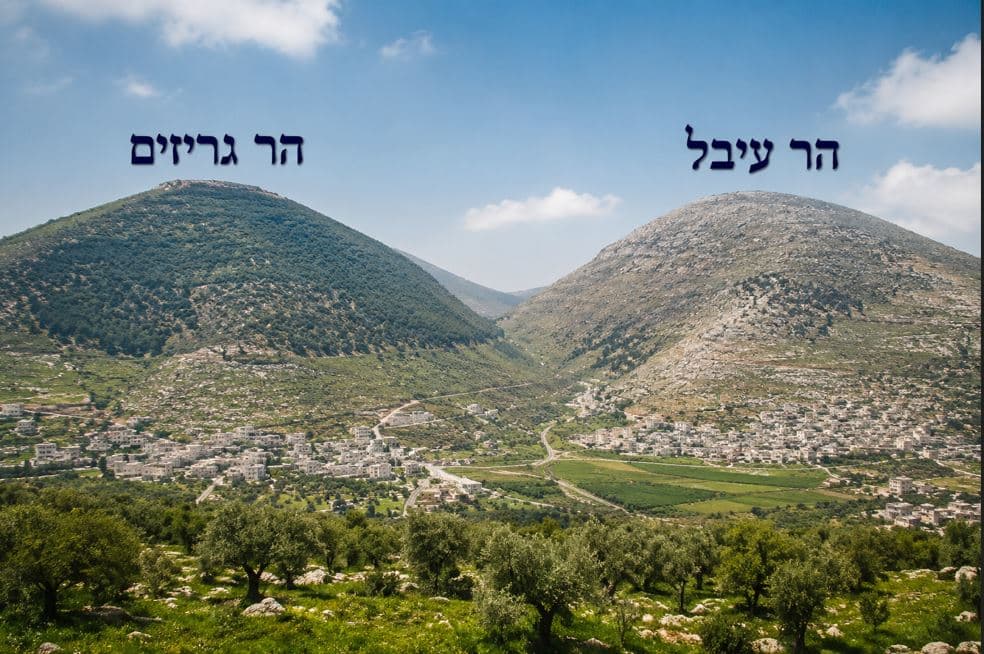
"And you shall set the blessing upon Mount Gerizim and the curse upon Mount Eival (Ebal)" (11:29)
A hint to the four righteous ones who died due to the counsel of the serpent
The man of the L-rd, the Kabbalist Rabbi Yehuda Fatiyah, ZT"L, in his book "Minchat Yehuda", hinted in this verse the names of the four righteous ones who died due to the counsel of the serpent (Shabbat 55b; Bava Batra 17a) according to what is said in the Zohar (Bereshit page 37 folio b), which are: Amram, Yishai father of David, Binyamin, and Levi. And this is what was hinted: "And the curse"—it is the curse of death that was given to Adam the first human, "upon Mount Ebal" [על הר עיבל], acronym of: Amram, Yishai, Binyamin [Benjamin], and Levi. That is to say, they passed away only because of the curse, but the rest of the righteous ones passed away not because of the curse, but rather because of the words of our Sages of blessed memory (Shabbat 55a) that "there is no death without sin."
"For you are passing over the Jordan" (11:31)
The great miracles that occurred at the time the people of Israel crossed the Jordan
In the Gemara' [Tractate] Sotah (page 33b): It is brought, Rabbi Yosi taught, saying: In three places priests bore the Ark, when they crossed the Jordan, and when they surrounded Jericho, and when they returned it to its place. And since the feet of the priests were dipped in the water, the water turned backward, as it is said (Yehoshua 3:15) "and when the bearers of the Ark came unto the Jordan etc. and the waters coming down from above stood, rising up in a heap" etc. And how much was the height of the water? Twelve mil by twelve mil, corresponding to the camp of Israel, the words of Rabbi Yehuda. [Since the size of the camp of Israel was 12 mil, therefore an area of 12 mil was emptied in the Jordan to allow the people of Israel to cross there.] Rabbi Elazar son of Rabbi Simeon said to him: According to your words, does a person move faster or does water move faster? You must say: that water moves faster than a person, if so, water would come down and wash them away? [Since water pours faster than the walking speed of man, it turns out that when the water reached a height of 12 mil, this was before the people of Israel completed the crossing at the Jordan, and if so, the water fell upon them?] Rather, it teaches that the waters were piled up and ascending layer upon layer more than three hundred mil, until all the kings of the East and West saw them, as it is said (Yehoshua 5:1) "And it came to pass, when all the kings of the Amorites who were beyond the Jordan westward, and all the kings of the Canaanites who were by the sea, heard how Hashem had dried up the waters of the Jordan from before the children of Israel until they were passed over, that their heart melted, neither was there spirit in them anymore, because of the children of Israel." And Rachav the harlot also said to the messengers of Yehoshua (Yehoshua 2:10) "For we have heard how Hashem dried up the water of the Red Sea," and it is written (there 11) "And as soon as we had heard these things, our hearts did melt, neither did there remain any more spirit" etc.
The Gemara continues, while they were still in the Jordan, Yehoshua said to them: Know upon what you are passing the Jordan—on condition that you dispossess the inhabitants of the land from before you. If you do so, it is good, and if not, the water comes and washes away otikhem. What is "otikhem"? It is a combination of the words me [oti] and you [etkhem].
While they were still in the Jordan, Yehoshua said to them (Yehoshua 4:5), "Lift up each man one stone upon his shoulder according to the number of the tribes of Israel," and it is written (there, 6) "That this may be a sign among you, when your children ask tomorrow saying: What are these stones to you?". A sign for the children that the fathers crossed the Jordan.
While they were still, Yehoshua said to them (Yehoshua 4:3), "Take up for yourselves from here out of the midst of the Jordan, from the place where the priests' feet stood, twelve stones, and carry them over with you and lay them down in the lodging place where you shall lodge tonight." Could it mean in any lodging place [perhaps the command here was that they should take the stones to every encampment place they would have?], the teaching says "where you shall lodge tonight." Rabbi Yehuda said, Abba Chalafta and Rabbi Eleazar ben Matya and Chananya ben Chakinai stood upon those stones, and they estimated each and every one to be equivalent to forty se'ah. And we have a tradition regarding the burden carried by a man on his shoulder, that it is [weight of each stone was 40 se'ah, and the carrier of a burden alone is] one third of the burden carried when others assist him to lift it. From here you can calculate for the cluster of grapes [what was the weight of the cluster carried by the spies] as it is said (Numbers 13:23) "and they bore it on a pole between two," from what is implied by "on a pole," do I not know that it was between two? What does the teaching say "between two"? It means on two poles [translation: a load upon a load. That is, two poles carried by 4 people, and under them two more poles, which were also carried by 4 people, total all carried the cluster eight people.] How so? Eight carried the cluster, one carried a pomegranate, and one carried a fig; Yehoshua and Calev did not carry anything. If you wish, say it was because they were prominent [Yehoshua and Calev did not carry, because of their importance]. And if you wish, say it was because that they were not in that counsel [that the intention of the spies in bringing the fruits was to say to the people of Israel: just as its fruits are strange, so its people are strange, and therefore Yehoshua and Calev did not assist with their hands in bringing the fruits]. Rabbi Ami and Rabbi Yitzchak Naphcha disagreed on this: one said according to the words of Rabbi Yehuda they crossed [the Jordan] in the manner [formation] that they camped, according to the words of Rabbi Elazar son of Rabbi Shimon they crossed one after the other. And one said between this Sage and that Sage there is an agreement that they crossed in the manner that they camped; one Sage holds man is light (swifter) and one Sage holds water is light (swifter). Up to here are the words of the Gemara.