
Praises of our Rabbi, the Ari, may his merit protect us, Amen.
Praises of our Rabbi, the Holy Ari, may his merit protect us, Amen: The history of his life, his birth, revelation of Eliyahu the Prophet, his holy customs, the Holy Spirit [divine inspiration], wondrous deeds, customs with his students, and rare stories from the book Praises of the Ari, of blessed memory.
Praises of our Rabbi, the Ari, may his merit protect us, Amen.
Praises of our Rabbi, the Holy Ari, may his merit protect us, Amen: The history of his life, his birth, revelation of Eliyahu the Prophet, his holy customs, the Holy Spirit [divine inspiration], wondrous deeds, customs with his students, and rare stories from the book Praises of the Ari, of blessed memory.
Date Line
1st of Av, 5786
The Birth of Our Rabbi the Ari, of blessed memory, the Circumcision, and His Descent to Egypt
Rabbi Shlomo Luria, memory of the righteous for a blessing, the father of our Rabbi the Ari, was a righteous man, wholesome and upright, who feared the L-rd, and departed from evil. On one of the days, behold, he was praying and supplicating in the synagogue in ancient Jerusalem, and no man was with him; Eliyahu the Prophet, remembered for good, appeared to him and said to him: "Know that the Holy One, blessed be He, sent me to announce to you that behold, your wife is pregnant and bearing you a son, and you shall call his name Yitzchak. And he shall begin to save the souls of Israel from the hand of the husks [forces of impurity], and a number of souls that are reincarnated from several years will he rectify! And through him the wisdom of Kabbalah shall be revealed, and no kind of wisdom in the world will be lacking from him, and his name shall go forth across all the land. Therefore, take care and be careful not to circumcise him until I come to be the sandek, and he will sit on my knees at the time of the circumcision."
And it came to be, as he finished speaking with him these words, he vanished from his eyes. And that man wondered greatly at this sight, and remained that entire day in the synagogue, weeping and praying to Hashem, blessed be He, and thus he said in his prayer: "Please, Hashem, fulfill this thing which You announced to me, and let no sin impede me in this matter—even though I am small and have no merit in me—for Your sake do, and not for my sake."
And with a good sign and good fortune, in the year 5300 [1540 CE], the tender child was born, and the entire house was filled with light. And on the eighth day they led him to the synagogue to circumcise [him] according to custom, and his father was looking all around the synagogue to see if Eliyahu, remembered for good, had come; and he did not see him. And he was in great distress, because all the people of the congregation were pressing him, saying: "Step forward, and hold your son to circumcise him!" But he was delaying, saying that all his relatives had not yet arrived; and this was about half an hour. And seeing his soul's distress, he wept a great weeping and prayed to Hashem; and while he was still weeping, behold, Eliyahu, remembered for good, came toward him. And he said to him: "Do not weep, servant of Hashem. Approach the altar and prepare your burnt offering, which is entirely whole to Hashem, and sit on the chair and hold your son before the eyes of the congregation, and I will sit in your lap and hold with my hands the feet of this child. And that which I was delayed from coming until now was in order to test you whether you would keep my instruction or not." And he sat on the chair joyful. And Eliyahu, may he be remembered for good, sat as he said, and no person saw him except he alone. And they circumcised the child and led him to his mother, and before he reached the house, the circumcision was healed like an infant circumcised several years ago.
And the child grew and was weaned, and they led him to the Torah school (Talmud Torah). And he was a great, wondrous, and mighty scholar—more than those of his age; and he would delve into the Talmud like a veteran scholar, and no master of Torah was able to stand before him due to the intensity of his analytical debate.
And when he was about eight years old, his father passed away to his eternal home, peace be upon him. And his mother said to him: "My son, behold now, I am a widowed woman and I do not have the ability in my hands to buy you books that you need. And now, come let us go down to Egypt to the house of your uncle, who is a very wealthy man, and there you will lack nothing, and you will be able to meditate in Torah to your soul's desire." And he said to his mother: "Here I am, and everything that you say to me I will do." And they arose and went down to Egypt, and they came to his uncle's house, and his uncle received him with great honor, and he became like a son to him. And he sent and called the Rabbi, our Teacher, Rabbi Bezalel Ashkenazi, ZLH"H, author of Shita Mekubetzet, and requested of him that he learn Torah with this youth; and he was with him until he was 15 years old, and then his wisdom surpassed all the wise men of Egypt.
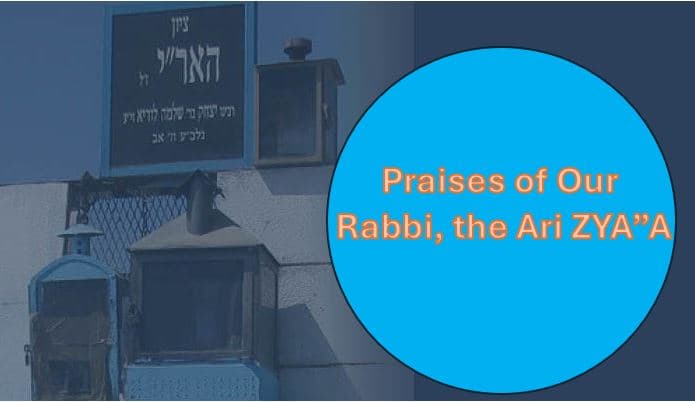
And then his uncle gave him his daughter as a wife. And it is written in Chibat Yerushalayim that the house in which our Teacher the Ari was born is near the Midrash Or HaChaim, and no man or woman shall dwell in this house. And behold now it is known to us from the mouths of speakers of truth—they have a tradition in their hands—that the place in which the Rabbi, the Ari, may his merit protect us, Amen, was born in Jerusalem is in the Upper Jewish Market. And recently they whitewashed and decorated it, and widened its windows, and it was filled with light; and every day they pray in it, and Torah scholars sit and engage in the wisdom of truth [Kabbalah] in it from morning until noon. Fortunate are [the people of] Israel!
Our Rabbi the Ari, of blessed memory, Studies the Holy Zohar and Secrets of the Torah in Egypt
One day he was sitting in the synagogue to pray, and a certain man was sitting next to him. And the Rabbi turned and saw a book in his hand, and he turned to it and saw high secrets in it. And after the prayer, the Rabbi said to that man: "Tell me what is written in this book." And the man answered and said to him: "What shall I speak? For Hashem has withheld honor from me, as I am from the Marranos [forcibly converted ones]. And because I saw everyone praying from a book, out of shame I took this book, and I do not know what is written in it."
The Rabbi said to him: "If so, sell me this book, and I will give you a prayer book as well." He said to him: "Am I lacking money that I should give you the book for money? Rather, tell your father-in-law that he forego for me the custom tax pertaining to my merchandise, and I will give you the book." And since the Rabbi was longing for this book, he implored his father-in-law, who listened to his words, and he took the book. And the Rabbi was delving into this book and into the Book of the Zohar with all his might, and with self-afflictions and fasts. And by means of these deeds, he merited that every night they would tell him in a dream that the understanding which he understood in the passage of the Zohar was not [the correct] understanding; and sometimes they would tell him that the understanding he understood was a correct understanding, but was not the intention of Rashbi [Rabbi Shimon bar Yochai]; and sometimes they would tell him that if he wants to understand the passage, he needs to do more self-afflictions. And so, he would do. And seeing this, he went and secluded himself in Old Egypt for six years, studying day and night in holiness and purity, until he merited that every night they would elevate his soul and ask it to which Academy on High it wants to ascend—whether to the Academy of Rabbi Eliezer the Great, or to the Academy of Rabbi Akiva, or to the Academy of Rashbi; and to the place it wants, they lead it, and they would impart to it awesome secrets, and in the morning he would not forget a thing and would reveal [it] to his students. And once the pious one, our Teacher and Rabbi, Rabbi Avraham HaLevi, testified that once on the Sabbath of Torah portion Balak, he entered his presence and found him sleeping the afternoon sleep—for the Rabbi, peace be upon him, said that it is a commandment to sleep the afternoon sleep on the Sabbath, and it is beneficial to the soul, unlike on weekdays when afternoon sleep is harmful to the soul. [This is] because if his soul gained some soul of a righteous person that joined with him at night during the time his soul ascended as a deposit for the purpose of Mayin Nukvin [spiritual arousal from below], as is known to those knowledgeable of the hidden wisdom—when he sleeps the afternoon sleep, that soul of the righteous person that came to assist him in commandments departs from him, and it is possible that the soul of some wicked man will clothe itself in its place to cause him to sin, since during the day the soul does not receive the Divine Presence in the secret of a deposit, as there is no need for it toward the spiritual union, and it remains wandering in the world in the air, and he can lose rather than gain. And this is specifically with the righteous, but with the wicked it is the opposite: sleep is good for them, on the grounds that perhaps [one] will merit the impregnation (Ibbur) of a pure soul, and their evil soul will depart from them. And our Teacher and Rabbi, Avraham HaLevi, found that he was whispering with his lips during sleep, and our Teacher and Rabbi, Avraham HaLevi, went and inclined his ear over the mouth of the Ari, of blessed memory, to know what he was speaking. In the midst of this, the Rabbi awoke from his sleep and saw him standing over him. He said to him: "What do you want here?" He said to him: "May your honor forgive me, for I saw the crown of our Torah whispering with his lips, and I inclined my ear in order to listen to what the crown of our Torah is speaking." He said to him: "Always when I sleep, my soul ascends Above through paths and routes known to me, and ministering angels come to meet me and receive my soul and bring me before (Mattatron) the Prince of the Divine Presence, and he asks me to which Academy I want to go, as mentioned above. And in those Academies, they impart to me secrets and hidden treasures of the Torah which were never heard and never known, even in the time of the Tannaim, peace be upon them.
Our Teacher and Rabbi, Rabbi Avraham HaLevi, said to him: "Will the crown of our Torah not reveal to me what they taught him now this time?" The Rabbi, peace be upon him, began to laugh and said: "I call heaven and earth to witness upon me, if I were to expound for 80 consecutive years without exaggeration, I could not finish what I learned this time on the Torah portion of Balaam and his donkey!" And all this he merited in the Holy Land after his ascent from Egypt.
Our Rabbi the Ari, of blessed memory, and His Holy Spirit in Tzfat (Safed)
An incident that occurred: The people of Tzfat appointed ten wise and discerning men—and among them the Ari, of blessed memory—to be appointed over transgressions. And one day, one of those appointed arose to go to the synagogue to be among the first ten as was his good custom, and he opened the window to see if the day had dawned, and he saw a decorated woman coming out of the entrance of her courtyard. And the appointee arose and went after her, and saw that she entered a courtyard where there was a man suspected regarding a married woman. And the appointee said: "Indeed the matter is known, that this woman is given over to prostitution!" And he set people to watch them from transgression. And the appointee went to the synagogue and commanded the shamash that after the prayer he should gather all the appointees, and he did so. And they all gathered, and the appointee stood up to testify about what he saw in the morning. And before he opened his mouth, the Rabbi preempted him and said to him: "Do not speak ill of proper daughters of Israel! For the woman whom you saw is clean of all sin, and therefore she went early in the morning so that people would not look at her. And the reason for her going was that there in that courtyard arrived a man from the West [North Africa/Morocco] who brought her a letter and a deposit from her husband, and she sent word to him saying that he should send her deposit to her, but he sent word to her saying that her husband imparted a secret to him to tell her, 'and words are not handed over to a messenger,' and therefore she went." And when the appointee heard this, he was silent and went to conduct an investigation into the matter, and it was found that the Rabbi's words were correct. And he came before him and said to him: "I have humbled myself to you, forgive me!" The Rabbi answered and said to him: "What have you done to me? Go to the woman and ask forgiveness from her for suspecting her!" And so, he did. And the Ari, of blessed memory, was established as a prophet. And even so, two great Torah scholars did not believe in him. And one day they came to test him, and found him outside and said to him: "Are you the man, the prophet, who knows what a person has done in his days?" And from his immense humility, he disavowed it to them and said: "I am no prophet, nor am I a prophet's son!" And while he was speaking, behold, a man passed by and touched the Rabbi's garment. And [the Rabbi] said to him: "May Hashem forgive you, for you have caused me to need several immersions [in a ritual bath] because of you!" And when they heard these words, they ran after the man and said: "Tell us, please
what you did that the Rabbi spoke thus about you! Tell us, and we will go with you to the Rabbi and implore his favor that he will give you a rectification (tikkun), for if not, he [i.e., you] will die without receiving discipline!" And then the man was terrified and said: "What shall I speak and how shall I justify myself? The L-rd has found out the iniquity of your servant, for tonight I was drunk, and the serpent seduced me, and I stumbled into a sin..." And it came to pass when the rabbis heard this, they marveled, and they went with that man before the Rabbi and implored his favor that he give him a rectification; and so, he did, and the rabbis did not depart from within the tent.
The Revelation of Our Rabbi, the Ari, of blessed memory, to the Maharchu [Rabbi Chaim Vital] ZLH"H
And all this time, the Maharchu was still in Damascus, and every night the Rabbi [the Ari] would draw out his soul and speak with him, and the Maharchu would get up in the morning and tell his students. He said to them: "There is an Ashkenazi scholar in Safed, and every night he draws out my soul and speaks with me that I should go to him so that he may teach me Torah." And he was almost wondering about him, according to his own view that he was wiser than him, as he was composing a commentary book on the Zohar. One day he encountered difficulty in a certain passage and exerted himself greatly to study it and did not understand it; and another day a second passage and did not understand it; and again, a third passage and there was no understanding. And seeing this, he said: "I will go up to see in Tzfat, may it be rebuilt and established speedily in our days, Amen, and also I will see the Rabbi—whether he is according to the rumor or not." And he arose and went to Tzfat, and on that very day upon his entry, he came before the Rabbi, who received him with a pleasant countenance and showed him honor. And the Maharchu asked him about the first passage in which he found difficulty, and he told him the understanding; he asked about the second, and he opened for him gates of light; he asked him about the third, and he said to him: "Thus far is the Sabbath boundary, for you are not worthy to hear more." And the Maharchu remained bewildered before the Ari, and he went out from his presence chagrined, came to his house, stripped off his clothes, put on sackcloth, and sat the entire day in a fast, weeping and praying to Hashem that He grant him favor and grace in the eyes of the Rabbi so that he would accept him as a student. And in the morning, he returned before the Rabbi and pleaded with him to accept him as a student. Then the Rabbi said to him: "It would have been proper not to accept you, because of the delay that you were delayed these three months; but the repentance that you did yesterday, availed you so that I will accept you and will not conceal a thing from you." And then he fell before him and said to him: "May the king live forever!" And he sat and studied with the companions, but he was learning and forgetting, until one day the Rabbi went with the companions to Tiberias and had him drink water from the Well of Miriam, and his learning was permanently established in his hand [retained].
He also merited that the Rabbi was able to recognize [secrets] in the facial visage of a person, and knew everything that had passed over him from the day of his birth, and the transgressions he committed, and for what purpose he came to this world to rectify. Also, the Rabbi was always going into the wildernesses to study Torah, and would say that one needs to do so in order to join oneself with the Divine Presence (Shechinah) that sits in exile; and he would eat bitter herbs to fulfill what is written, "And thorns and thistles" [Genesis 3:18]. Also, the Rabbi would study in the Gemara six ways according to the plain meaning (Pshat), corresponding to the six weekdays, and one way according to the secret meaning (Sod), corresponding to the Sabbath day.
Two Ravens, Souls of Balak and Balaam, That Came to Receive Rectification (Tikkun) from the Ari, of Blessed Memory
One day while they were studying, the Rabbi turned and saw two ravens in a tree, and their plumage was plucked. And he said to them: "Wicked ones! In this world you sought to uproot a whole nation, and now in your distress you have come to me? Go on your way!" And they fled and went away. And the companions asked: "What is this thing?" And he replied: "Know that these ravens are Balak and Bilaam, who were taken out of Gehenom [Hell] to be entered into another Gehenom harsher than it, and they came to request of me that I pray for them to save them from Gehenom; therefore. I spoke thus to them."
Two Female Demons That Came to Cause [People] to Sin
Also, one day while they were studying, the Rabbi said to the companions: "I see two decorated female demons entering a certain room where two young men are, to defile them. And I have the ability in my hands to save them, but since they caused it to themselves by engaging in sorcery, I am not saving them; for regarding this our Sages of blessed memory said, 'One who comes to defile himself, they open [the door] for him.'" And the companions conducted an investigation, and found that the Rabbi's words were correct.
The Plague of Locusts That Almost Happened in Tzfat Because of a Poor Man in the Time of the Ari, of Blessed Memory
One day in the middle of study, the Rabbi said: "Be silent!" And afterward he said: "Blessed be the True Judge." They asked him: "Why did [the Rabbi] speak thus?" He said to them: "Know that I heard the proclamation announcing in the firmament that locusts will come upon the entire border of Tzfat and eat all the grass of the land, and will leave no sustenance in Tzfat. And all this is because of a certain poor man whose name is Rabbi Altaraz, who sits and complains against the Holy One, blessed be He, over his bad fortune, and weeps in the bitterness of his soul. And Hashem, blessed be He, cannot restrain Himself over his evil neighbors who know of his distress and have no mercy on him; therefore, this decree was decreed. Therefore, for the sake of Hashem, collect money among yourselves and bring [it] to this poor man—perhaps G-d will think of us and we will not perish." And so, they did, and they collected among themselves about five gold coins and sent them to him via one of the companions. And he came to his house and found him lying on the ground, crying out and weeping. And the companion said to him: "What is with you that you cry out?" He said to him: "Shall I not weep over my bad fortune? For my entire livelihood and the livelihood of my household was that I would fill water and sell [it], and today the beams fell and the barrels and jars broke, and I have nothing with which to buy others in their place, and for this I am weeping before Hashem", saying: "Am I more wicked than all the world?" And it came to pass when the companion heard that the Rabbi's words were correct, then he gave him the money and said to him: "Because of you a decree was decreed upon us; therefore, forgive us and pray to Hashem that He annul the decree!" And so, he did, and he cast himself to the ground and wept before Hashem that He annul the decree. And the companion returned to his place and told the companions, and they returned to study. And in the middle of study, the land grew dark, and they raised their eyes and saw a heavy army of locusts, and they feared greatly. The Rabbi said to them: "Do not fear, for the poor man has already forgiven his insult, and the decree has been annulled, and now do not fear." And so it was, and Hashem turned a strong wind and carried away the locusts; not one locust remained in all the border of Tzfat. The Rabbi said to them: "Blessed shall you be, for because of you the decree was annulled!" And from that day onward, all the people of Tzfat were looking out for that poor man.
The Souls of the Righteous Came as Birds to the Ari, of Blessed Memory, and the Companions
One day the Rabbi said to the companions: "Know that tomorrow we will read a passage from the Book of the Zohar, and it is difficult to understand; therefore, delve into it well." And they said: "So we will do." And at night each one delved into it, and in the morning they all came and asked one another concerning the understanding of the passage, and they were all found equal in [their] understanding. And they said: "Is it for no reason that the Rabbi said it is difficult? Therefore, let us review the text." And so, they did, two [or] three times and did not innovate anything. And they sat down to study before the Rabbi, and he said to them: "Are you all equal in understanding, or does each one have a different understanding?" And they said to him: "We are all equally well [agreed], and we wonder at the words of the Master who said that it is difficult to understand, and it seems like a scribe's error (Ta'ut Sofer)." The Rabbi said: "There is no error in it; therefore, let one of you state the understanding that he understood." And so, they did, and one of them began to state the understanding that they understood. And while he was speaking, some birds came and cackled much. The Rabbi said to the companion: "Be quiet! For these birds are the souls of the righteous that came from the Garden of Eden to tell you that you are mistaken in the understanding, for according to your understanding there are such and such difficulty/questions—therefore be quiet, and I will tell you the correct understanding." And so, it was. And when he finished the understanding, the birds flew away, and the companions remained embarrassed. And they said one to another: "Where is our wisdom? Where shall we carry our disgrace? Were we blind that we did not see the difficulties?" The Rabbi said to them: "Even according to your understanding, there are such-and-such secrets; and I spoke for your merit and for the honor of the righteous who came."
The Attainment of the Ari, of blessed memory, in Sleep and Awake, and the Prohibition of Writing to the Companions
Also, one day he was sleeping the afternoon sleep, and his lips were moving/whispering, and the Rabbi, our Teacher and Rabbi Avraham Baruch, inclined his ear near the Rabbi's mouth to listen. And behold, the Rabbi woke up and found him standing over him, and he said to him: "May the Master forgive [me], for because I saw the lips of a righteous person moving, I inclined my ear to listen." Then the Rabbi laughed and said: "If you knew what my soul received tonight in the Torah portion of Bilaam's donkey—and I call heaven and earth to witness upon me—that if I were to sit eighty years, I would not finish saying [it]." The companions said to him: "Why does the Master not compose a book from his wisdom?" He said to them: "It is impossible, because everything is tied together, and when I open my mouth to expound to you, it strengthens and flows like a gushing and overflowing spring, and I seek a small and thin pipe so that you can listen and not lose everything like an infant choking from abundance of milk. If so, how shall I compose a book, and how shall I tell you what my soul received? Therefore, let each one write what he heard from me; and with all this, permission was not given to write except specifically to the Maharchu [Rabbi Chaim Vital], as he gets to the bottom of my mind." And even so, everyone was writing, until one day it happened that he called to the Torah scroll for the companion Moshe Meshullam at the verse And Moshe wrote. And when he descended from the pulpit, he came to kiss the Rabbi's hands. The Rabbi said to him: "Did I not tell you saying that you shall not write what you hear from me?" And they answered him: "Our Master, from the day you commanded us, we have not written!" He said to him: "Does the Torah lie, Heaven forbid, where it is written And Moshe wrote? And furthermore, the pamphlets in your lap will testify that they are your handwriting from recently!" And then he was terrified and did not answer.
An Incident with the Ari, of blessed memory, and a Student of the Ramak, of blessed memory
One day the Rabbi was expounding, and there was a student from the students of our Teacher, the Ramak [Rabbi Moses Cordovero]. And he turned [his mind] to one thing that the Rabbi said—that he dissented from his teacher [the Ramak]. And the Rabbi turned to one side and said to him: "Your teacher is sitting here, and he told you that you are lying/mistaken, and it is not according to your words!" He answered and said to him: "Who proves [this]?" He turned another time and spoke to him in the name of his teacher: "And if you [do not] believe, go to your house and take a certain book at a certain page, and you will find as I said." And so, he did, and opened and saw that the Rabbi's words were correct, and he came and conceded to him.
An Incident with the Ari, of blessed memory, and the R.S. Uzida, of blessed memory
One day the R.S. Uzida entered before the Rabbi, and the Rabbi stood up before him and seated him to his right, and spoke with him as much as was needed, until the matter was wondrous in the eyes of the companions. And when he went out, the Maharchu [Rabbi Chaim Vital] said to him: "What is today, that you showed so much honor that you did not show several times when he went out and came in?" He said to him: "Not on his account did I rise, but on account of Rabbi Phinchas ben Yair who entered with him because of a commandment that he did, which he used to do." And when the Maharchu heard this, he arose and ran toward him and adjured him, saying to him: "By the life of my master, tell me what commandment you did today that the Rabbi spoke thus!" He said to him: "I got up in the morning to go to the synagogue according to my custom to be among the first ten, and I heard a sound of great weeping, and I inclined myself to know what the matter was. And I saw people all naked and weeping, for thieves had come upon them at night and stolen everything they had; and my compassion was aroused, and I stripped off all my clothes and gave [them] to them, and the proof is that I am wearing Sabbath clothes." And it came to pass, when he heard this, he kissed him on his head and blessed him.
An Incident of the Ari, of blessed memory, and His Student with the Chickens
One day the Rabbi said to one of the companions: "Go outside, for he is separated [excommunicated]!" And he went out from his presence and observed rebuke upon himself the entire day, and was weeping and praying all day to Hashem that his sins should not cause them to reject him from his presence. And it came to pass in the morning that he came before the Rabbi, wept and pleaded with him that he tell him what sin he committed so as to repent (Teshuvah). He said to him: "Because of the chickens in your house that have been in a fast these three days and are crying out to Hashem; therefore, they distanced you from Heaven. But if you take upon yourself that you will not rely on your wife, and every day in the morning you will give them to eat, then I will release [the ban] for you." And so, he did, and he released [it] for him.
An Incident of the Ari, of blessed memory, with the Tax Collector Reincarnated as a Mouse
One day while they were studying, the Rabbi said to the companions: "Do you know So-and-So (the collector who used to gather custom taxes and has already died)?" They said: "May his name be erased!" He said to them: "Bring me a trap." And they brought [it], and the Rabbi placed it in a certain spot, and immediately a mouse fell [into it]. And the Rabbi spoke with the mouse before everyone, and said to it: "What did you think when you were an informer and informant, destroying the money of Israel—that there is no judgment and no Judge, Heaven forbid?" Then the mouse wept and pleaded with him that he pray to Hashem and save it from several troubles of reincarnation so that it might enter Gehenom [Hell]. And he said to it: "Go out from here, for you are not even worthy to enter Gehenom!" And he opened the trap and it went out, and they saw this and marveled.
An Incident with the Ari, of blessed memory, and his student Rabbi Avraham Brochim, of blessed memory, and in the Idra
One year, the Rabbi went to Meron with his son, and they sat there in joy, with food, song, and drink, and the companions with him. And the Rabbi Brochim was accustomed to say "Console us, Hashem our L-rd" in the blessing "Builder of Jerusalem," and there too they said [it], and then the Rabbi fell asleep and woke up, and said to him from Rashbi [Rabbi Shimon bar Yochai]: "Why did you say console on his hillula? Therefore, in another seven days he will say [it] over his son." And so, it was.
And the Rabbi said that there is a root and a great secret in this, and it is not fitting to be sad in those days. And from there they went to the place where Rashbi and his companions gathered to study the Idra, and the Rabbi sat in the place of Rashbi and set each one of them to his place, and they studied the Idra there.
And the Rabbi said that each one has a spark from the companions of Rashbi, and he revealed deep secrets to them. And he said to them: "If permission were given to the eye to see, you would see a great assembly of righteous ones and ministering angels who came to hear the Idra from our mouth, and a flame of fire surrounds us until we finished the Idra."
An incident of the Ari, of blessed memory, and the companions at the marker of Shemaya and Avtalyon
One day the Rabbi went with the companions to Gush Chalav, to the (burial) marker of Shemaya and Avtalyon, and made a yichud [kabbalistic unification]. And when he finished, he said to the companions in their name that they should pray that Messiah son of Joseph will not die in their days. And due to his great humility, he did not reveal to them that he himself was the Messiah until the day of his death.
An incident of the Ari, of blessed memory, and his student in a yichud at the graves of the righteous
One day the Rabbi handed over a yichud to one of the companions, that he should go and perform it over all the righteous ones, and the righteous one would hand over and reveal [secrets] to him, but on the condition that he does not speak to any person and does not give greetings to any person.
And the companion went and performed the yichud, but the righteous one did not reveal anything to him.
And he came before the Rabbi, and said to him that the righteous one did not reveal anything to him. And the Rabbi answered him: "And why did you not keep my words? For behold, in such-and-such place you extended a greeting to so-and-so." And then the companion confessed to the words of the Rabbi.
An incident of the Ari, of blessed memory, and his student the Maharchu [Rabbi Chaim Vital], of blessed memory, regarding yichudim [kabbalistic unifications] at the graves of the righteous
One day, the Rabbi handed over a yichud to the Maharchu to perform at the grave of Abaye and Rava which is in Avnit, and so he did.
And when he returned, he came before the Rabbi, and the Rabbi stood up to his full stature before him and showed him great honor.
And the Maharchu said: "What is today different from other days?"
And he answered him: "I did not stand up because of you, but rather because of Benayahu son of Yehoyada who came with you."
And the Maharchu replied: "My master, it is not appropriate, measure for measure that that those who the yichud was intended for them that they come, not Benayahu!"
And the Rabbi answered him: "Know that in the place where you sat to perform the yichud, Benayahu son of Yehoyada is buried there, and since he that was mentioned touches upon the root of your soul, therefore he came with you."
And one day, the Rabbi went with the companions to Avnit, and in the middle of the way, the Rabbi said to the Maharchu: "Here is buried Benayahu, of blessed memory, and here you sat to perform the yichud."
And then the Maharhu remembered and acknowledged the words of the Rabbi.
An Incident of the Ari, of blessed memory, and palmistry [wisdom of the hand]
Once, on the eve of Purim, the Maharchu called a certain widow who was in his neighborhood, and said to her: "Sew two gold coins into your garment, and tomorrow come before the Rabbi with your daughter, and ask him for Purim money. And when the Rabbi says 'give her,' say to the Rabbi: 'The charity that I ask from him—he should look at my daughter's hand and tell her, her mazal [destiny/fortune].'"
And the Maharchu did this thing with cunning, because he had labored much with the Rabbi so that he would teach him the wisdom of line-reading of the hands, but [the Rabbi] kept pushing him off with words: "Now, when the Rabbi says 'this line indicates wealth' or something similar to it, it will be learned [by me]."
And it was in the morning, and the Rabbi was preaching to the companions on the laws of Purim, and behold, the woman came.
And she said: "My master knows that whoever stretches out their hand, we give to him, and all the more so for a widow like me?"
The Rabbi said: "Give her [money] to fulfill the commandment of Purim."
Then the woman replied: "Even though I am a widow, I am not so poor, for I am nourished by the work of my hands. But this charity they should do for me: that you look at my only daughter's hand and tell her, her mazal."
And [the Rabbi] said to her: "Schemes like these will not avail the Maharchu regarding this matter, for I knew that he was there behind these words! Even so, I will not send you away empty-handed. Tell your daughter to step back and put her hands on the pillar."
And she did so, and he told her everything that had passed over her from the day of her birth, and what would reach her until the day of her death.
And the Maharchu was terrified, and did not set his heart further to this wisdom.
And [the Rabbi] said to him: "Did I not tell you, 'It is sufficient for you in the wisdom of Kabbalah, from which you will know everything'?"
An Incident of the Ari, of blessed memory, and the young man who married a female demon (shedah) and regretted
An incident that occurred in Tzfat, may it be built and established quickly in our days, that a few young men went out to stroll in the field. And while they were sitting, they saw a finger coming out and entering into the ground.
One of them said in jest: "Who will put my ring on the finger for the sake of betrothal?"
One of them stood up and put his ring on the finger, and the finger was covered with the ring, and they panicked and returned to the city. And as time went on, the matter was forgotten.
And after days, the young man was betrothed to a virgin maiden. And when the time of the wedding arrived, the congregation gathered to hear the seven blessings, and behold, a woman cried out, saying: "What fault did the groom find in me that he wishes to marry another woman after he betrothed me? Therefore, if you execute Torah law for me, good; and if not, I will kill the groom and the bride! For behold, the ring is in my hand!"
And she showed it to all, and they recognized it as having the groom's name engraved on it. Immediately, the father of the bride took his daughter and went to his house, and the joy turned into mourning, while the woman remained with the groom.
And the Rabbi sent after the groom, and spoke with him in private: "Do you wish to marry the female demon or not? And do not fear, for I will save you from her."
Then the young man replied: "Who is the fool that desires to marry a female demon? And what can I do about my bad fortune? Oh, that my leg had been broken that day and I had not gone out to stroll!"
[The Rabbi] said to him: "Return to your house."
And he commanded the shamash to summon the female demon to stand before him in judgment. And the shamash went and searched for her in all the house and did not find her. And he returned before the Rabbi and said: "I did not find her."
And [the Rabbi] said to him: "The Rabbi says to you: She is in the house, and because of fear she hid from you. Therefore, go back and reach for the ladder and say: 'The messenger of the Rabbi says: If you come, good; and if not, I will excommunicate you and your family!'"
And so, he did. And as soon as he finished speaking, the woman came down and walked after the man and came before the Rabbi.
And he said to her: "What do you have to do with this young man? Go and marry a demon like yourself!"
And the woman answered: "Is this the law? Since he betrothed me, I can marry another?"
[The Rabbi] said to her: "These fall into the category of betrothal by mistake, for he did not see your face and did not know that you were a female demon, and in jest he put his ring on your finger."
And even so, she answered him regarding every matter, until the Rabbi shouted at her and said to her: "Even though this is not the law, I will act so that he gives you a bill of divorce (get). And if you will not accept a get I will put you in Cherem and all that is connected to you"
Immediately he called a scribe and wrote her a get. And she accepted [it], and he adjured her with a severe excommunication that she would do no harm to the groom, nor to his bride, nor to anything they have.
And the woman went away.
And the Rabbi sent after the father of the bride that he should return his betrothed to him, and so he did.
An Incident of the Ari, of blessed memory, who revealed the secret nistar venizok [hidden and harmed]
One day they were studying in the Book of Zohar in Parashat Beshalach, in the passage "The Holy One, blessed be He, prepares for the Ayala one snake etc."
And the Rabbi said: "Here there is a great secret, but there is no permission to reveal it because of danger." And concerning this, Rashbi said: "In this matter do not ask and do not test Hashem," strictly so. And concerning this [it says]: "And Moshe fled from before it."
And the companions and the Maharchu did not listen to him and urged him until he explained the passage.
And when he finished, he said to them: "How many times did I tell you that there is danger and you did not listen to my voice? Now a decree has been decreed against my son Moshe that he will die in another seven days."
And the companions were terrified very much. And the Rabbi stood up and went to his house and asked his wife about his son Moshe, and she said: "about an hour ago that he came from the school with a headache?"
And behold, he was lying on the bed, and the Rabbi went up to him and saw his flesh hot like a burning fire, and the Rabbi already knew that he would pass away and that seven days would not suffice until the Rabbi's son passed away.
And they repented and it did not avail them. And after his mourning, he sent after them—who were ashamed and came before him—and said to them: "Do not fear that because of the passing of my son I will hide from you a thing, heaven forbid; I will not withhold from you a thing."
And then they fell before his feet and said: "May the King live, and his sons forever!"
An Incident of the Ari, of blessed memory, and Rabbi Moshe Alshich, of blessed memory
One day Rabbi Moshe Alshich came before the Rabbi, and said to him: "What is my transgression and what is my sin that your honor keeps pushing me off with words? And why shall I not be like one of the companions?"
And the Rabbi said to him: "Did I not say to your honor that you did not come to this world except to fix the pshat [literal sense of Torah]? And the secret—his soul already completed [it] in another reincarnation when he was Chutzpit the interpreter, and he is a spark from him. And if he does not believe my words: tomorrow is Friday, let him go and sit in such-and-such place where we pass by the way there to receive the Sabbath. If he sees us, then he will know that I am pushing him off with words; and if he does not see us, he will know that he did not come to the world for this wisdom and then he will be appeased."
And in the morning, he bought the needs of the Sabbath, and before noon he dressed in Sabbath clothes and went and sat there in the place that the Rabbi told him, and sat watching.
And at the hour that the Rabbi came upon him, a deep sleep fell upon him, and he slept, and the Rabbi passed by and returned and did not see him, until the Rabbi said to the companions to wake him up lest the people of the village kill him.
And they woke him up and he arose startled and said: "What is this that I was watching out, and now a deep sleep fell upon me?"
The Rabbi, of blessed memory, said to him: "Was it not so that I told you of honorable stature? Therefore, be strong and courageously strengthen yourself in your commentary in which you will enlighten the eyes of the generations."
And through these deeds, his name went out in all the world.
An Incident of the Ari, of blessed memory, and the wealthy man from Turkey who sinned
There were people from Constantinople who came to see the face of the righteous in Tzfat and saw the greatness of the Rabbi, and upon their return to Constantinople, they related some of the praises of the Rabbi.
There was a wealthy man there who did not leave a transgression that he did not commit, and when he heard such, he said: "I will go to Tzfat and see if the Rabbi will tell me all that I have done, and I will return by means of this in repentance."
And he went out of the city, and in an inn where he stayed, he took a cup of wine to drink to test him. And while the Rabbi was studying, he laughed.
The companions asked him: "What is this laughter?" He said to them: "Know that a wealthy man went out from Constantinople, and he is standing in an inn in such-and-such place with a cup of wine in his hand to test me, 'By my life and by your life, and so-and-so [i.e., let's drink a toast]', and on such-and-such day he will come. Therefore, be careful with him, for he is a great soul of Achav (Ahab) king of Israel."
And that wealthy man came to Tzfat (Safed) before the Rabbi, and the Rabbi showed him great honor. And he said to the Rabbi: "If you tell me all that I have done, I will return by means of this in repentance, and if not, heaven forbid I will say: there is no judgment and there is no judge.
And then the Rabbi commanded all the companions to go out from before him, so as not to humiliate him.
And then he said to him: "You are So-and-so, son of So-and-so, from family So-and-so, and you did such-and-such on such-and-such day, and in such-and-such place with a certain woman, and he did not leave a thing that he did not tell him;" until he was terrified before him and said to him: "I have sinned! And by means of you, I will return in repentance".
Then he gave him a great tikkun [rectification/penance], and he sent after his wife and his sons, and he settled in Tzfat in complete repentance.
An Incident of the Ari, of blessed memory, and the one who returns in repentance and his tikkun
An incident A story of a certain man who came before the Rabbi, and [the Rabbi] said to him: "Are you the prophet who knows all that a person does in inner chambers?"
He said to him: "I (am)." He replied to him: "If you tell me what I have done, I will accept repentance, and if not— all actions are equal to me."
And the Rabbi drew him close and told him what he had done from the day he was born, and also that he came upon his maidservant, and in everything he confessed except for the maidservant, whom he denied.
The Rabbi said to him: "If you want, now I will show her to you, what will you say?" Immediately the Rabbi put his hand upon him and brought her out [spiritually/visionally].
And when he saw her, he recognized her, so that his soul nearly departed, and he fell before my legs and said: "I have sinned, and twisted, and transgressed!"
And the Rabbi returned and restored his soul to him, and the man cried out in a bitter voice and pleaded with the Rabbi to remove [the sin] from upon him.
And [the Rabbi] said to him: "Know that our Sages, of blessed memory, said: 'One who comes upon a gentile woman, she is bound to him like a dog even in the World to Come, and to this she is bound and does not depart, except through great repentance and through rectifications.'"
He replied: "Behold, I am ready even for the four court-ordered executions!"
The Rabbi said to him: "For his rectification is by burning." Immediately he took out money to buy wood for burning.
The Rabbi said to him: "Our laws are not like the laws of the nations, rather it (the burning punishment) requires pouring (molten) lead as the law requires." The man said: "Let it be as it may, behold I will die!" Then the Rabbi commanded that they buy lead, and they brought it and put it on the fire, and he told him to say the confession of a critically ill person (shechiv mera), and so he did.
Then [the Rabbi] said to him: "Throw yourself to the ground!" And he threw himself to the ground.
And [the Rabbi] said to him: "Stretch out your legs, stretch and extend [them], stretch your hands and extend [them], close your eyes and shut [them], open your mouth."
And he opened [it], and [the Rabbi] threw into his mouth sweet confections that had been prepared.
And he said to him: "And your iniquity is removed and your sin atoned for, and you shall not die."
And he raised him up from the ground, and [the Rabbi] wrote rectifications (tikkunim) for him.
And among the rectifications was that he should read every day five pages of the Book of Zohar, even without understanding.
And he sent for his wife and his sons, and he settled in Tzfat in complete repentance all his days.
An Incident of the Ari, of blessed memory, and the young man who married and his wife died
One day, a certain young man came before the Rabbi and kissed his feet, and said to him that his desire was to go abroad, so that he would tell him what would come upon him.
And the Rabbi said to him: "May Hashem direct your way, and go in peace. And there you will take for yourself a very beautiful woman with a large dowry, and you will be married to her for six months, and the woman will die.
And you will inherit nothing from her except six hundred gold coins.
And the reason is that this woman came in a reincarnation after a man who was rich and was your companion, and he distressed you for six months, and in the end led you to gentiles and caused you to lose six hundred gold coins.
And now she has come to pay back to you corresponding to the six months that he distressed you—that you will delight with her in her beauty—and the six hundred gold coins corresponding to the six hundred gold coins that he caused you to lose.
Therefore, even so, say to him: 'It is forgiven to you!'" And so, it was.