
The Hilula of Rabbi Shmuel Salant - 29th of Av
Once, a woman came to Rabbi Shmuel Salant with a bird [poultry] to ask a kosher status question. The Rabbi inspected the bird and saw there was nothing wrong with it. He said to her: "Go home and bring the second bird." And in that second one, there was indeed the problem! They asked him: "Honored Rabbi, how did you know?" He said: "Look, there was no flaw on this bird... there was no real question here. So why did she come? Obviously, she must have had another bird."
The details about Rabbi Shmuel Salant, ZT"L are from a video by Rabbi Benayahu Yissachar Shmueli, Shlit"a on the 29th of Av, 5784
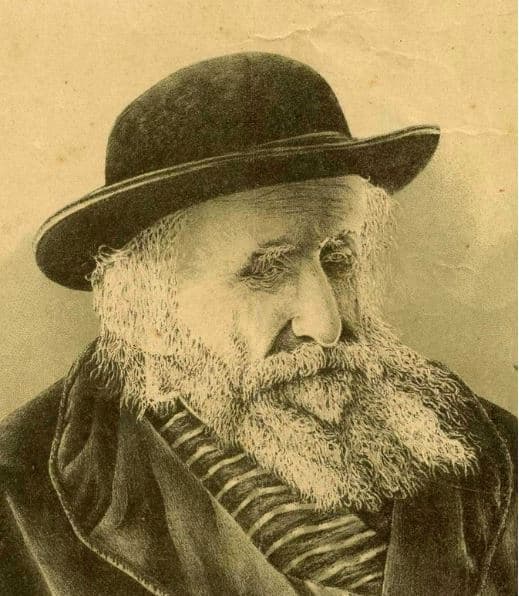
But as for today, it is the anniversary of the passing (yahrzeit) of Rabbi Shmuel, Rabbi Shmuel Salant. You know, Rabbi Shmuel Salant was the Chief Rabbinical Judge (Av Beit Din) of Jerusalem.
He passed away in the same year that Rabbi Yosef Chaim [the Ben Ish Chai] passed away. Rabbi Yosef Chaim passed away in 5669, on the 13th of Elul, and he [Rabbi Shmuel Salant] on the 29th of Av—a few days before Rabbi Yosef Chaim. You see? Two weeks.
He was the Rabbi of Jerusalem. He studied in Volozhin, then immigrated to the Land of Israel, and... he built the Etz Chaim Yeshiva. He built it. Wondrous and amazing. He was a truly special Jew.
(Audience member asks: Was he blind?)
Huh? Yes, that's... no, Etz Chaim in the Old City. Afterwards he also built... apparently this came from that as well. But he immigrated to Jerusalem and lived in the Old City in the courtyard of the Hurva Synagogue. He had a two-room apartment there—no bathroom, no kitchen, nothing. That's where he lived.
The whole world used to come to him there. He had a table near the entrance, and everyone would come. Montefiore came to visit him there; he sat in his home. Montefiore, Rothschild... everyone visited him there. Every afternoon, he would sit out in the courtyard for a bit to get some fresh air, and everyone would come up to him—talking to him, asking him questions. He paid attention to every child, kissed every child. They say he was extraordinary.
One day, a certain man walked in. The Rabbi honored him, gave him something to eat, and said to him: "Now that you have your strength back, sit down." He called two other rabbinical judges (dayanim) and said to the man: "Now, whatever I tell you to do, you do. You are writing a bill of divorce (gittin) to your wife."
The man asked: "What?!"
"Yes, you are not leaving this room."
Well... the Rabbi said to him: "She has been trapped as an agunah because of you for many years. Sit down! Write the divorce. What is your name?" He brought the scribe of the rabbinical court, they wrote the get, and the Rabbi told him: "Appoint me as your proxy, and that's all."
And so he was forced to do it.
Afterwards, they asked the Rabbi: "How did you know?"
He said: "They came to me several years ago [about this case], and I stored his face right here in my memory. I told myself that whenever he came near me, I would catch him. I said to myself, 'Now I see him. Here is that picture!' I gave him food first and made sure everything was fine, and now I caught him."
That's how he was—something special. They say he possessed wonderful wisdom.
He relates another story: Once, a woman came to Rabbi Shmuel Salant with a bird [poultry] to ask a kosher status question.
The Rabbi inspected the bird and saw there was nothing wrong with it. He said to her: "Go home and bring the second bird."
And in that second one, there was indeed the problem!
They asked him: "Honored Rabbi, how did you know?"
He said: "Look, there was no flaw on this bird... there was no real question here. So why did she come? Obviously, she must have had another bird."
He was so clever—he had such sharp intuition.
He relates another story: Once, a little girl came to him holding a bird—her mother had sent her.
The Rabbi examined it carefully, thought and pondered, and finally said: "This is non-kosher (treif). There is nothing to be done, take it."
Right after that, he dispatched his attendant (shamash) and said: "Go immediately and give her money so they can buy a new bird."
They asked: "Honored Rabbi, why?"
He said: "Listen, this bird is non-kosher, but it is likely the only food the entire family has to eat."
Truly wondrous, isn't it?
Another time, a bird was brought to him that was completely infested with lice. They asked him: "What is the ruling?"
He looked at it and said: "I have never seen so many lice." He said: "It's treif!"
They asked him: "Why? Is lice considered treif?" [That is to say, why not just remove the lice and make the bird fit to eat.]
"Does it [this type of bird] pick out the lice?"
He said: "Yes. He asks: Why does it have lice? Because it cannot move its head. Apparently, something inside it is broken. If it could move its head, it wouldn't have lice; it would clean them out. A bird cleans itself. It simply wasn't able to move its head."
They asked him: "Where is that written [in the law books]?"
He replied: "That doesn't need to be written down—it just takes common sense!"
So yes, that was Rabbi Shmuel Salant.
There was another incident showing his cleverness:
A woman once came to him... a family that was preparing meat for a wedding. The wedding was scheduled for that very night, but milk had spilled into the meat pot.
Now, according to halachic law, this presents a major issue. The Rabbi inspected it carefully, looking for a solution...
He said: "Wait here, bring me the cooked dish."
Yes, he then called the milkman and asked him: "Tell me... tell me the truth, how much water did you dilute the milk with?"
And once he knew that, he was able to rule the food kosher for them!
There was also a remarkable event involving him... how... it was like this:
A telegram arrived in the month of Tammuz in the year 5665 [1905]. Four years before... he passed away at an advanced age, 94 years old.
The letter arrived in 5665. At the time, the Rishon LeZion [Chief Sephardic Rabbi] was Rabbi Elyashar.
A long telegram arrived containing around 113 words.
The telegram stated that the entire Jewish community in Międzyrzec, Poland was desperately pleading for immediate help from the people of Jerusalem. Why? Because two Jewish men currently residing in Jerusalem had given false testimony.
And this supposedly false testimony had implicated five Christians in a murder trial.
With the court ruling pending against them, if the sentence were executed, a grave danger threatened all the local Jews.
As a result of anti-Semitic hatred, a severe tragedy would unfold.
"Our plea to the Rabbi is to demand that the witnesses in Jerusalem retract their testimony and immediately report this to the Russian Consul..."
And so forth. Warsaw region.
The telegram stated that during the interrogation of the two men, their testimony—given abroad at the time—had led to the conviction of Gentiles, and that it was truthful.
However, they warned that a threat of a pogrom was imminent, making the matter extremely grave and complex.
Rabbi Elyashar convened the leaders of the Jerusalem community for a consultation.
After a lengthy discussion, Rabbi Elyashar declared: "In my opinion, this telegram is a forgery!"
He explained: "It is possible that Rabbi Rabinowitz—who is signed on it—knows nothing about it, or was forced to sign. But it appears to me that this telegram was actually sent by the family of the murderers. They want to save their relatives. That is why they want the testimony revoked, and that is what could actually spark a pogrom."
Well...
Since not everyone agreed, a heated debate broke out over the matter.
Rabbi Elyashar told them: "Send a messenger to Rabbi Salant. Whatever he says, we will do."
They brought the telegram to him as it was.
He took one look and also declared: "This is a forgery!"
Now, when they told him that Rabbi Elyashar had said the exact same thing, he remarked: "Two prophets prophesying in the same style!"
Look at what... what righteous men they were! What holy men, what remarkable stories, huh? Isn't it wondrous? Truly wondrous!
How they... Rabbi Shmuel Salant, may his merit protect us.