
Translation from the Chizuk-Yomi 16th of Av - "But to Fear"
The Sha'agat Aryeh said: "Ever since I performed this commandment, all the gates of Heaven were opened to me. I became a completely different person," he said. "And then I composed the important books of the Torah."
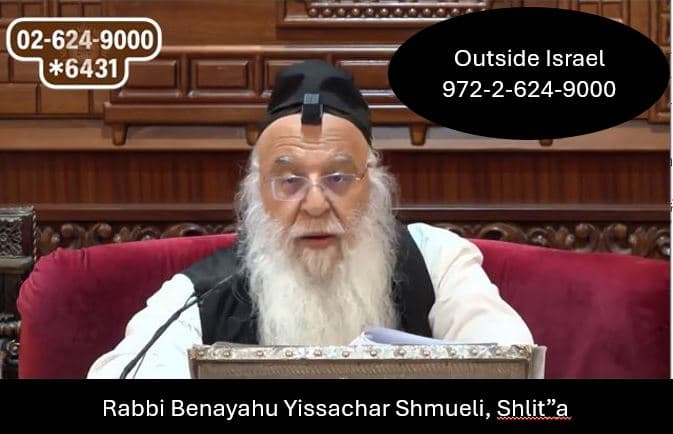
Good morning to everyone. Today, Thursday, on the Holy Sabbath week, 16th of Menachem Av, 5786 (5786 / 2026). On Thursday, we prepare ourselves through repentance and good deeds to receive the light of the Sabbath Queen, with G-d's help. The second Sabbath of the "Seven of Consolation," Parashat Ekev, "And it shall come to pass, because ye hearken."
"And now, Israel, what does Hashem your L-rd require of you, but to fear..."
The Holy One, blessed be He, asks of us only to fear Him.
The Noda BiYehuda says: There is nothing in the world where a human being can act first with goodness toward the Holy One, blessed be He. Why? A person performs a circumcision for his son — he says, can you perform a circumcision if He didn't give you a son? He gave you a son, so you perform a circumcision. One builds a railing for a roof — where can you make a railing? He gave you a house, so you can make a railing. A person attaches tzitzit — He gave you a shawl, you have a garment, so you can attach tzitzit. Charity, giving tithes — where do you get money from?
The Holy One, blessed be He, preceded us with goodness before we even perform the commandment. As the sage says in Pirkei Avot: "Give Him from His own, for you and yours are His." Namely, there is no debt on the part of the Holy One, blessed be He, toward man. The Holy One, blessed be He, has already given to us beforehand; rather, in His great kindness, He pays a reward to man as if the man performed the commandment from himself, from his own.
However, regarding fear of Heaven, the Holy One, blessed be He, entrusted this commandment into the hands of man. Free choice is entirely in man's hands — whether to be G-d-fearing or not. Therefore, a person who properly fulfills the commandment of fear of Heaven, the Holy One, blessed be He, is obligated to reward him; it is not given to him for free.
And this is what it means: "And now, Israel, what does Hashem your L-rd sho'el (require/borrow) of you" — meaning, sho'el in the sense of a loan, as if you are lending it to Him — "but to fear." That is the commandment.
The 300 Rubles
When the Sha'agat Aryeh... married the daughter of one of the great wealthy men. He made a condition in the engagement that the Sha'agat Aryeh would eat at his father-in-law's table all the time. Not much time passed, and his father-in-law called him and said: "One cannot know what a day may bring. You sit at my table all the time, but I have money now — take 300 rubles (which was a lot of money), hide them, and it will serve you in time of need." He took them, put them away, and did not use them.
One day, one of the town's wealthy men — a prominent supporter — came to him and said: "Honored Rabbi, look. Tomorrow my daughter is getting married." — He said to him: "I don't know where can I go to." — He said: "I promised the groom such and such, 300 rubles. And I have nothing to give him, nowhere to borrow from, nowhere to take from, and I am in deep trouble," weeping and crying, "the wedding will be canceled..."
A bad reputation and great shame, something... The Sha'agat Aryeh saw that his grief was truly genuine grief, and that he was speaking about a true situation...
He gave him all the 300 except for five rubles. The man said honorable rabbi, if you are already doing the mitzva, why not bring five more.
He said to him: "The evil inclination comes and says to me, 'Look what a righteous person you are, you gave all...' " He said: "Because of this, I do not give everything. The mitzva is only called upon the name of the one that completed it; if someone gives you five, he has merited it."
The Sha'agat Aryeh said: "Ever since I performed this commandment, all the gates of Heaven were opened to me. I became a completely different person," he said. "And then I composed the important books of the Torah."
This is one of the great things. There is another matter: "And now, Israel, what (mah) does Hashem your L-rd require of you?" You know that our Sages expounded: Do not read it as mah ("what"), but as me'ah ("a hundred"). This is Rabbi Meir, specifically in the Talmudic tractate of Menachot. Rabbi Meir says: A person is obligated to recite one hundred blessings every day, as it is stated, "What (mah) does Hashem your L-rd require of you." Rashi explains: Read mah as me'ah, meaning that the Holy One, Blessed be He, asks of you a hundred—a hundred blessings.
One hundred blessings every day. "And now, Israel, what does Hashem your L-rd require of you," and then a person will merit, as it were, "to fear the L-rd your G-d". And this is the halakha (law): A person is obligated to recite one hundred blessings every day. Every single day, one hundred blessings.
I remember Hacham Ovadia used to count the blessings; he would count them. Especially on Shabbat—because go figure whether you have a hundred blessings or don't have a hundred blessings, what is going on with you? Because on Shabbat, blessings are lacking. So, he used to count them. That is how he would do it, counting them.
"Only to fear..." You know, the number of letters in this verse—"And now, Israel, what does Hashem your L-rd require of you, only to fear"—is ninety-nine letters. No, excuse me, ninety-nine, he says. And if you read the word mah as me'ah, adding an extra letter, then it becomes exact.
The Ba'al HaTurim says: "He has told you, O man, what is good, what Hashem your L-rd requires of you (mimecha)." You know what is good? What Hashem requires of you: Mem-Mem-Kaf (mimecha). The numerical value of Mem-Mem-Kaf is one hundred (Mem = 40, Mem = 40, Kaf = 20). It means He requires of you one hundred blessings every day.
The author of Da'at Zekanim says: "We give thanks to You (Modim anachnu lach)"—see, the word Modim also equals one hundred. Modim: Mem and Mem [80], Vav, Dalet, Yod [20]—Modim. "We give thanks to You"—whoever recites one hundred blessings every day for the honor of Hashem, Blessed be He, that is "We give thanks to You."
The Chida, in his book Chaim, says: "Open wide your mouth and I will fill it"—"Open wide" refers to the letters Pei and Hei (spelling "mouth"). Bless Hashem with this. The letters Pei and Hei spelled out phonetically: Pei-Hei...
Letter Calculations and Gematria:
Do Pei, Hei, Hei, Yod — exactly 100. Expand Pei — expand the letter of Pei: write Pei and Hei (85); Hei (Hei and Yod, 5 &10) — 100.
The Power of Blessings to Open the Heavens
Therefore, a person must open his mouth wide and fill it, and then the Holy One, Blessed be He, fulfills his heart's desires for good. That is to say, if a person recites 100 blessings every day and does not know which blessing it is, help will come to him from Heaven. What salvation will come to him from Heaven! Great salvation will come to him from Heaven. So, this is a great thing. One of the greatest things is for a person to strive to properly recite the 100 blessings.
Teachings of the Ramchal and Man's Original Height
So, the Ramchal says, as the verse states: "Blessed be the L-rd, who daily heaps us with benefits." Each day, give Him a measure similar to His blessings. Indeed, our Sages of blessed memory said: Adam, the first man, stretched from the earth to the sky. Once he sinned, the Holy One, Blessed be He, placed His hand upon him, diminished him, and set his stature at 100. Man's stature itself is 100 cubits, corresponding to the secret of the 10 Sefirot, each consisting of 10. And the Holy One, Blessed be He, diminished him. But if a person recites these blessings properly, the Holy One, Blessed be He, elevates him — spiritually speaking.
The Virtue of Shabbat and Completing 100 Blessings
Now, on Shabbat, we are lacking blessings. As it is written: "The thousand are for you, O Shlomo, and two hundred for those who tend its fruit." For every blessing a person recites, he receives 10 gold coins. The thousand — every day the Holy One, Blessed be He, gives 1,000 gold coins. Each blessing is worth 10, totaling 1,000 for a person. So, every day check your bank account — 1,000 gold coins enter daily. "The thousand are for you, O Shlomo" — but on Shabbat, 200 are missing, because 20 blessings are missing on Shabbat. So, 200 gold coins are missing — "and two hundred for those who tend its fruit." These are the people who recite blessings over fruit, ground produce, increase their blessings with fragrant spices, baked goods — organizing and completing the blessings.
The Presumption of Righteousness and the Majority of Years
So that’s two hundred. If a child is in kindergarten, where will they get it from? "Companions listen for your voice" — they hear the blessings and fulfill their obligation when a person listens.
Know this: our Sages ask a great thing — if the majority of a person's years pass in goodness, they will no longer sin. If during the majority of their years they did not sin, they will not sin. Therefore, regarding this, the verse states: "What does the Hashem your L-rd require of you, but to fear [Him]..." If forty-one years passed in goodness, one will no longer sin. The days of our years are seventy years, and if by reason of strength, eighty years. Now, half of eighty is forty. Forty-one represents the majority of one's years. It means that if a person was worthy and merits reaching great strength (eighty years), someone who remains observant for 41 years is set. That is what our Sages say. But only if during his first 41 years he was righteous — otherwise, no!
Numerical Equivalences (Gematria) and Reverence
Know that it is written in Sefer Hasidim: there are three distinct terms that share the exact same Gematria (numerical value):
- "Ki im le-yir'ah" ("but to fear")
- "Torah"
- "Yir'at Hashem" ("fear/awe of G-d") — Yir'at, Torah, and Gmilut Chassadim (acts of loving-kindness) share the exact same Gematria. Yir'at equals Torah in numerical value — the exact same number. Gmilut Chassadim is also the exact same number.
See what a great principle this is! How do you serve awe/fear of Hashem? Through Torah and through acts of loving-kindness. Beautiful. "You shall fear Hashem your L-rd" — this includes Torah scholars.
The Blessing of Rain and the Story of Nakdimon ben Gurion
A great matter. We have already said that these are also sins that a person treads upon with their heels... And then a person merits: "A land which the eyes of Hashem your L-rd are always upon... drinks water of the rain of heaven." It should have phrased it as "drinks water from the rain of heaven"; why does it say "you shall drink"? It implies that man's drinking comes directly from the rain. Rain falls, and then there is drink. From the rain of heaven — then you shall drink water. That is the blessing.
You know the story of Nakdimon ben Gurion. Nakdimon ben Gurion saw the pilgrims coming up to Jerusalem and there was no water; there was a great shortage. He borrowed twelve wells of water from a certain Gentile landowner. He said to him: "Lend them to me." The landowner replied: "Certainly." Nakdimon said: "Listen, if by a certain day they refill with rain, we are set with what Hashem has provided. If they do not refill, I will pay you for everything and reimburse you in full with money." The landowner accepted the terms.
So, he took them on loan relying on the expectation that rain would fall. In the end, that day arrived, and the sky was completely clear — blazing sun! The landowner came to him and said: "Sir, either give me back my water or pay me the agreed amount of gold and silver as promised; hand it over." Nakdimon replied: "I still have the entire day remaining."
[It is] afternoon, he says "well, well," he says "there is time." He comes to him close to night time and (Nakdimon) says: "There is time, another hour." What did Nakdimon ben Gurion do? He entered the Holy Temple, crying to Hashem, blessed be He, and praying that He bring rain. Meanwhile, that man [the Roman creditor] went and entered the water cisterns. He was swimming in the cisterns, feeling pleased with himself, saying: "Now I am going to become a millionaire. Nakdimon ben Gurion has a vast amount of money, and he promised me that if rain does not fall, he will give me money."
In the meantime, the sky darkened with thick clouds, and then a heavy downpour of rain fell from the sky, filling up all his cisterns. The non-Jew came to him and said: "Do not be so happy. Still, yes, this rain did not fall while it was under your timeframe; it fell when the time was already mine." Nakdimon said to him: "Wait." He prayed to Hashem, the clouds dispersed, and the sun came out. He said to him: "Don't talk nonsense. Everything came from Heaven; Hashem gave it. From the rain of the heavens you will drink water. A wonder of wonders!"
Abundance always comes from Hashem, blessed be He. How He watches over the Land—a wonder of wonders! "A land which Hashem your L-rd cares for; the eyes of Hashem your L-rd are always upon it, from the beginning of the year to the end of the year." Divine Providence is constantly centered primarily on the Land of Israel. The Holy One, blessed be He, cares for all lands, but the primary care and supervision is like the human heart—positioned in the center, giving vitality to all the organs. The Land of Israel is directly under the rule of Hashem, blessed be He. There are lands under the stars and constellations, not directly under Hashem, blessed be He; but regarding the Land of Israel: "All my springs are in you." My providence and focus are on the Land of Israel—a land that Hashem your L-rd cares for continuously. A wonder of wonders!
Our Holy Temple and our glory—what a privilege it is! It is said that the lower Temple corresponds directly to the Heavenly Temple above. When we pray and perform good deeds, divine influence descends from above, from the Heavenly Temple down to here. A land of wheat, barley, grapevines, figs, and pomegranates; a land of olive oil and honey. A wonder of wonders!
The Aliyah of Rabbi Eliyahu Mani
Know that when Rabbi Eliyahu Mani immigrated to the Land [of Israel], he was still young. So, he says, when he arrived here to the Land of Israel, he stayed—he says that here in the Land of Israel he would sit and dedicate himself solely to Torah study and service of Hashem. Indeed, that is what he did. Rabbi Yosef Chaim—even the father of Rabbi Yosef Chaim, and Rabbi Yosef Chaim himself—supported him. They owned a factory in Baghdad, a business, and through it they provided for their own family as well as for Rabbi Eliyahu Mani. Every month they sent him a stipend. Whatever budget he needed, they sent to him. He also served as the Rabbi of Hebron, writing works purely for Heaven's sake. Why? Because Rabbi Yosef Chaim paid him all the money he needed. Any halakhic questions they had, they dispatched to him. He was a holy, pious, and ascetic man.
So, he set out on the journey with his wife (the sister of Rabbi Abdallah Somekh) and his three children, taking a camel caravan along with him. It was a difficult journey. While they were in the desert, Shabbat was approaching. Rabbi Eliyahu said to the workers, the camel drivers, and all the Arabs: "We are stopping here. I want to rest for Shabbat." But they refused. So, Rabbi Eliyahu said: "Go on ahead. I am staying here with my family"—his young children and his wife. He showed no signs of worry whatsoever. The sanctity of Shabbat... He relates that on Shabbat, all around them were the howls of wild beasts and predatory animals. Yet Rabbi Eliyahu recited the Kiddush over wine just as he used to do back home in Baghdad—literally. Singing Shabbat melodies, and not a single creature approached him. Leopards, foxes, and wild beasts passed by. Once Shabbat ended, they wished to continue. The caravan they didn't believe that such a thing was possible. That they all remained alive—they couldn't believe it. They were... only bones remained of them, or so they thought. But when a person comes with all his heart…
The same thing happened with Rabbi Yosef Chaim when he ascended to the Land of Israel. Back then, there was a non-Jew guiding them who said, "Under no circumstances am I staying here." Rabbi Yosef Chaim told him, "Go." So, he went and hid in a crevice of the rocks, while the Rabbi remained with his family. There were two wealthy men with him—Gabbai and Sassoon. They came with him, ascended with him, along with his brothers. They traveled together, making up a fine delegation.
Journey Through the Desert and Miraculous Protection
They pitched a tent in the desert and kept the Sabbath. His baker was with him—he always brought his baker along so he could prepare bread for him; he always needed him by his side to bake whatever bread he desired. They would gather wood, place a large pan over it, set up an oven, and right there he would bake the Rabbi whatever bread he requested. Especially for the Sabbath, when twelve loaves of pita were required—he took care of everything for him. He relates that bandits came to attack them. The moment they looked upon the Rabbi's face, they all froze like stone. They began to cry and weep uncontrollably, unable to move, until the Rabbi took pity on them and told them they could leave. They departed immediately and said to him, "We have hunting rifles. We will stand guard around you—there are wild beasts here—and we will protect you. You saved our lives." And that is exactly what happened: they stood around and guarded Rabbi Yosef Chaim.
Arrival in Israel and Searching for a Mikveh
Eventually, he made it to the Land of Israel. Upon arriving, Rabbi Yosef Chaim was overjoyed. He declared, "There is no way I am setting foot on the soil of Israel without first immersing in a mikveh." His brothers said to him, "Where are we supposed to find a mikveh right now?" He replied, "Dig right where you are standing. Dig into the ground, and you will find a spring—immerse in that." And that is precisely what occurred.
Visits to Jerusalem, Hebron, and the Cave of the Patriarchs
Their passport was a single document for everyone together. It was from that passport photo that they later produced his portrait, yes—wondrous miracles. They were brought from there and entered the Land of Israel. Then, before entering Jerusalem proper, he went first to Beit-el in the Old City. The YARE was there—Rabbi Yedidya Rafael Abulafia. They conversed, and he was delighted to see the prayer books (siddurim) of the Rashash and everything else. Then he said to him, "I want to go to Hebron, to Rabbi Eliyahu Mani; he is expecting me." He replied, "Go ahead." But when he was halfway there, Rabbi Yedidya Rafael Abulafia sent an urgent message recalling him. He told his companions, "I will return and visit him." By the time he returned, Rabbi Abulafia had passed away—he wasn't very old when he died, the YARE, Rabbi Yedidya Rafael Abulafia. Nevertheless, he reached the home of Rabbi Eliyahu Mani, was exceedingly happy, and was received with great honor in Hebron.
The Effort to Redeem the Cave and the Journey to Meron
He said to Rabbi Eliyahu Mani—after seeing the presence of the Ishmaelites at the Cave of the Patriarchs—he said to Rabbi Eliyahu Mani, "Look, I will do whatever it takes; I will bring a lot of money and redeem the Cave from the hands of the Ishmaelites." They summoned all the Ishmaelite leaders and set a meeting. He said, "Give them money... name whatever price you want." They quoted a massive price. He said, "I am going back to Baghdad to bring the money." In the end, they backed out and refused. But he says he had agreed to... agreed with them to purchase all of Hebron! The entire Cave of the Patriarchs. What spiritual strength he had, what vision! How joyous he was to visit Rabbi Eliyahu Mani. Afterward, he went up to Jerusalem and then traveled to Meron. There he danced during the Lag BaOmer celebration—he danced and composed the song "Ish Elohim Kadosh" ("Holy Man of the L-rd") and "V'amartem Koh Lechai". "Ish Elohim Kadosh"—that is his composition! A wealthy man heard it and said to him, "I will engrave all these words for the Rabbi on a plate of gold." He made the whole thing on a golden plate for Rabbi Yosef Chaim. Accompanying him were two very prominent, wealthy gentlemen...
The Greatness of Rabbi Yosef Chaim and His Elul Routine
That period of time was something truly grand. What great merit they possessed! And then he returned to Baghdad. How old was he when he succeeded his father's rabbinic seat? At the age of 26. He was effectively the sovereign leader of all Baghdad. What does "sovereign leader" mean? He determined the affairs in all places and across all matters.
Every Eve of Rosh Chodesh Elul, and throughout the entire month of Elul, he would go into seclusion. He would travel up to the tomb of the Prophet Yechezkel in Baghdad. It was located quite a distance from the main city of Baghdad where he resided. He arranged it so that no one would approach him or disturb him. He would take a building where everyone remained outside while he stayed inside alone. He sat and studied all day long, desiring to speak with no one.
The Postcard with the Clock and the Value of Time
If there were extremely urgent queries, knowing where he was stationed, people would send him a telegram. He would receive it. Someone once sent him a postcard... rather, sent him a question. The Rabbi responded to him: "Look, this matter is not so urgent, yet I am writing back to you..." He took a postcard that had a picture of a clock on it. He said: "Do you see this clock? To me, every single minute—every minute is as precious as a whole month. During the month of Elul, every single hour—every hour is like an entire month! That is why I sent this specific card to you. Why so? Because every hour is like a whole month, every single hour!" What fortitude they possessed, what immense strength! Tremendous spiritual power!
Serving Hashem and the Exegesis of the Verse
To serve Hashem with all our heart and with all our soul. "From the beginning of the year unto the end of the year". As you know, the word "Merashit" (from the beginning) in the Torah text is written defectively, missing the letter Aleph—spelled M'reshit. This provides an allusion to the month of Tishrei (reshit and Tishrei, contain the same four letters)—which marks Rosh Hashanah for the creation of the world. From Rosh Hashanah, judgment is passed... "From the beginning of the year unto the end of the year"—what is the meaning of this verse? It means that on Rosh Hashanah, it is already judged and determined what will occur at the year's conclusion. That is to say, whatever happens now at the end of the year was already decreed for us back on Rosh Hashanah. Everything is fully judged on Rosh Hashanah.